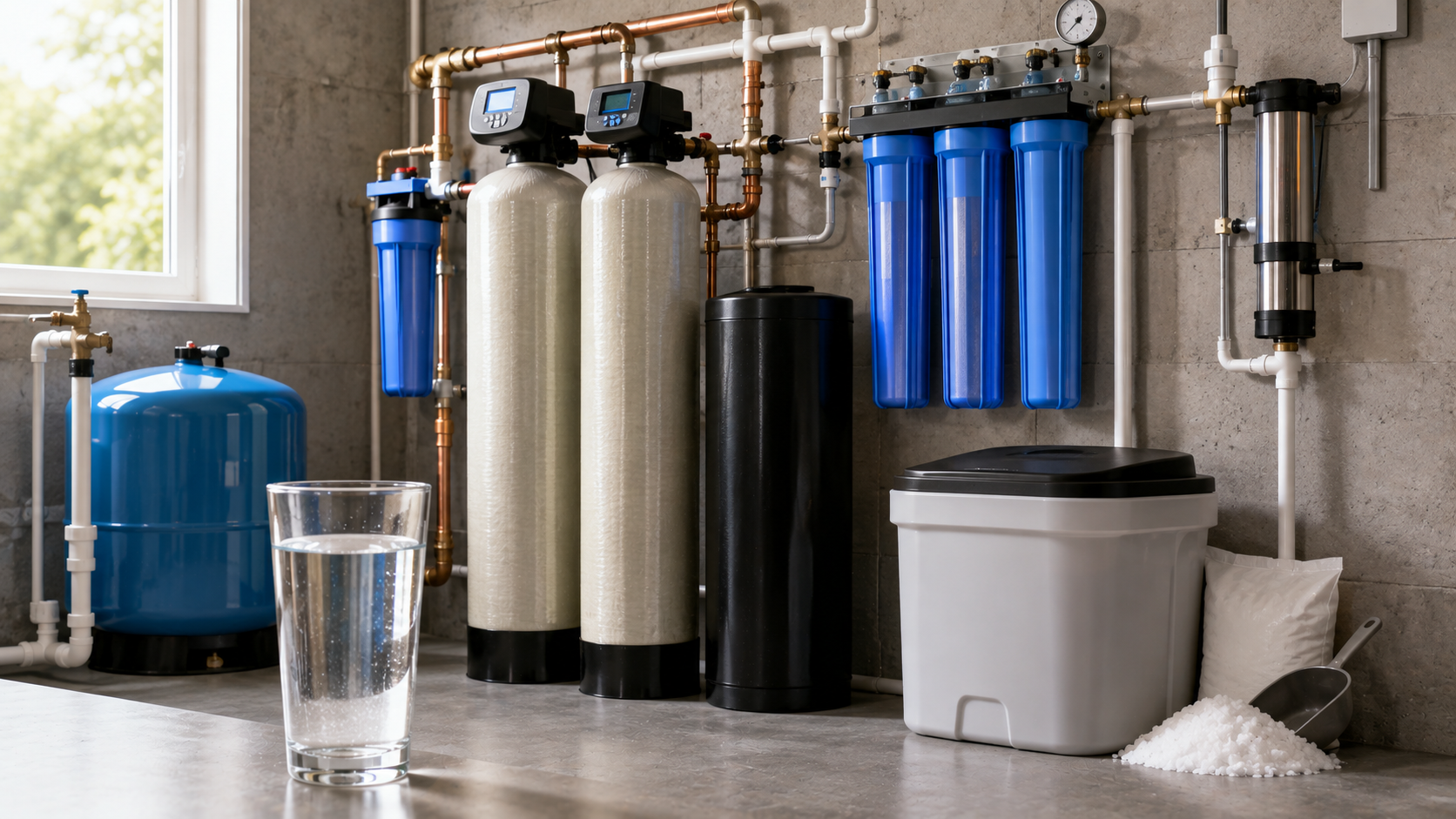
Private wells give homeowners direct access to groundwater, but they also place responsibility for water quality and maintenance on the property owner. Minerals, microorganisms, sediment, and naturally occurring contaminants can all affect a well supply.
The right treatment depends on the specific problem. Testing should therefore come before purchasing filtration or treatment equipment.
Hard Water and Mineral Scale
Hard water develops when groundwater contains elevated amounts of calcium and magnesium.
Common signs include white scale on faucets, spotted dishes, soap scum, and mineral buildup inside water-using appliances. Over time, these deposits can affect plumbing and equipment performance.
A water softener addresses hardness through ion exchange. The process removes hardness minerals and replaces them with other ions, helping reduce scale throughout the home.
Iron and Rust-Colored Stains
Reddish or brown stains around sinks, toilets, fixtures, and laundry can indicate iron in well water.
Iron may also create a metallic taste or affect water appearance.
Treatment depends on the type and concentration of iron present. Oxidation followed by filtration is one common approach, while more specialized iron-removal equipment may be necessary for certain water conditions.
Manganese and Dark Staining
Manganese can produce brown or black stains on fixtures, plumbing surfaces, and laundry.
Like iron, treatment should be based on laboratory results and overall water chemistry. Oxidation and filtration are common approaches, but the ideal configuration depends on concentration and other characteristics of the water.
Rotten-Egg Odor
A persistent rotten-egg smell can indicate hydrogen sulfide or certain bacterial activity.
Treatment options may include:
- Oxidation
- Activated carbon filtration
- Specialized odor-removal systems
Because several conditions can produce unpleasant odors, identifying the source helps prevent investment in equipment that does not solve the underlying problem.
Sediment and Cloudy Water
Sand, clay, silt, rust, and other suspended particles may enter a private well.
A sediment filter captures larger particles before they reach household plumbing or more specialized treatment equipment.
Sediment filtration is often used as a pretreatment stage because cleaner incoming water can help protect downstream filters and other components.
Bacteria and Microorganisms
Microbial contamination can occur following flooding, well damage, construction problems, or other events that allow contaminants to enter the supply.
Existing contamination may require well disinfection. UV treatment can also provide ongoing protection by inactivating certain microorganisms.
UV systems work best when water is sufficiently clear. Sediment or other substances that interfere with UV exposure may need to be removed first.
Nitrates
Nitrates can enter groundwater through fertilizers, septic systems, animal waste, and agricultural activity.
The challenge is that nitrate contamination cannot necessarily be identified by taste, smell, or appearance. Laboratory testing is essential.
Treatment options can include reverse osmosis, distillation, or specialized nitrate-reduction technologies. The appropriate system depends on contamination levels and household requirements.
Arsenic
Arsenic occurs naturally in groundwater in some areas and can become a health concern at elevated concentrations.
Certain reverse osmosis systems and specialized adsorption media can reduce arsenic.
However, arsenic treatment requires careful system selection. Its form, concentration, and other aspects of the water chemistry can influence which treatment method is appropriate.
Low pH and Corrosive Water
Acidic water can gradually corrode pipes, fixtures, and other plumbing components.
This deterioration can shorten plumbing life and potentially contribute additional materials to household water.
Neutralizing filters or chemical-feed systems can raise pH and reduce corrosivity. Testing establishes the existing pH and provides the information needed to select an appropriate treatment approach.
Why Water Testing Should Come First
Appearance, smell, and taste provide useful warning signs, but they cannot identify every well-water problem.
Private well owners should conduct appropriate testing for bacteria, nitrates, pH, and other contaminants relevant to local conditions.
Additional testing may be appropriate after:
- Flooding
- Well repairs
- Changes in taste, odor, or appearance
- Nearby construction or land-use changes
- Suspected contamination
Testing gives you measurable information instead of forcing you to diagnose water problems based on symptoms alone.
Choosing the Right Well Water Treatment
There is no single treatment system that fixes every private-well problem.
A household with hardness and iron may need both softening and filtration. Another with sediment and microorganisms could require pretreatment followed by UV disinfection. Reverse osmosis may be useful for specific dissolved contaminants, particularly when treatment is needed primarily for drinking and cooking water.
Before choosing equipment, review your laboratory results, household flow requirements, treatment capacity, maintenance needs, replacement costs, and relevant independent certifications.
The goal isn’t to install as many treatment stages as possible. It is to build a system that addresses the specific problems found in your well water while avoiding unnecessary equipment and maintenance.
Leave a Reply