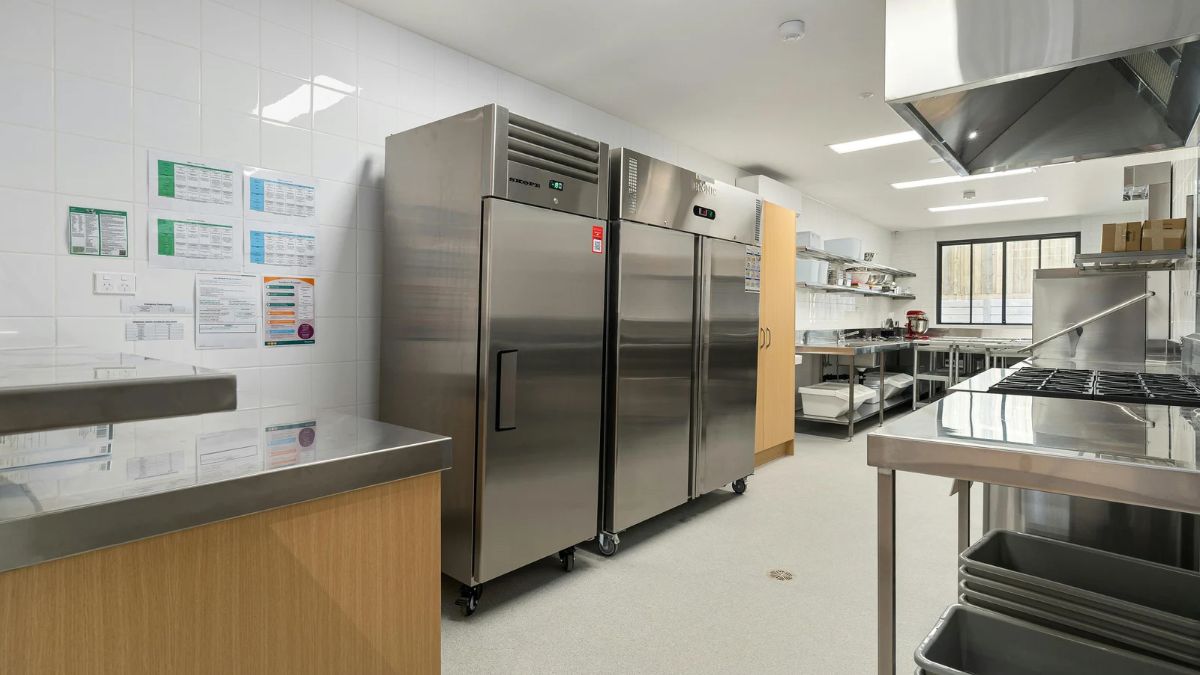
A commercial refrigerator should fit the way your kitchen works, the food you store, and the space available for installation. Price and exterior size matter, but neither tells you whether staff can reach ingredients during service or whether the unit has enough usable storage for your busiest day.
List what you plan to refrigerate, delivery frequency, and where employees need access. Check actual specifications, not only product photos.
Select the Right Refrigerator Type
Reach-in units provide general storage in prep rooms and production kitchens. Undercounter models keep frequently used ingredients near a station without taking up as much floor space. Worktop refrigerators combine chilled storage with a usable top, subject to the manufacturer’s intended use and load limits. Prep tables place chilled ingredients close to sandwich, salad, or pizza assembly.
Glass-door merchandisers display packaged products, while walk-ins serve operations with much larger storage needs. If your line needs quick access, a walk-in may still need a smaller unit nearby.
Measure the Unit and Its Route In
Record the width, depth, and height of the installation space. Include handles, casters, hinges, and the clearance needed to open doors and remove shelves. Check the delivery route through entrances, hallways, elevators, and turns. A refrigerator that fits its final position may still be too large to reach it.
Leave the ventilation and service clearances specified by the manufacturer. Confirm that door swing will not obstruct a busy aisle or collide with another piece of equipment. If a model offers reversible doors, verify that the change is approved and practical for your layout.
Calculate Usable Capacity
Estimate how much refrigerated inventory you hold before and after deliveries, including peak periods. Compare shelf arrangements, pan compatibility, and usable interior dimensions rather than relying solely on stated volume. Your team should be able to group foods logically and retrieve them without pulling out unrelated containers.
Avoid choosing capacity so tightly that the cabinet must be packed full. Appropriate airflow and a clear arrangement make temperature checks, cleaning, and stock rotation easier. Adjustable shelves can help you accommodate changing container sizes as the menu evolves.
Verify Temperature and Door Performance
Check the refrigerator’s operating range against the products you intend to store and the food-safety rules that apply to your business. An accessible temperature display is convenient, but your team should verify actual storage conditions under its procedures. Consider the kitchen’s ambient temperature and how often staff will open the doors during service. www.fda.gov
Solid doors suit back-of-house storage where visibility is less important. Glass doors let staff see contents before opening and support merchandising, but compare the particular models’ insulation, energy use, and cleaning needs. Half doors or multiple compartments may limit how much of the cabinet is opened for a small retrieval; evaluate whether that benefit fits your workflow.
Compare Energy Use and Construction
Review published energy-consumption information for comparable models. ENERGY STAR certification can help identify eligible efficient units, though not every refrigerator category qualifies. Compare the total ownership cost, including electricity, maintenance, and likely repairs, alongside purchase price.
Inspect hinges, handles, gaskets, shelving, and interior surfaces. Frequent opening and cleaning put these components to work every day. Removable shelves and accessible surfaces can simplify sanitation. Check whether replacement parts and qualified service are available in your area before selecting an unfamiliar model.
Check Installation and Support
Verify voltage, phase, amperage, plug type, and any dedicated-circuit requirement with the product documentation and your installer. Review ventilation, ambient-temperature, and placement limits as well. Top- and bottom-mounted compressors can affect service access and interior layout, so compare the actual unit rather than assuming one location is always better.
Confirm any sanitation and electrical certifications your jurisdiction requires. Read the warranty’s coverage for parts, labor, and the compressor, including exclusions tied to installation or maintenance. Know who will service the unit if it stops cooling during a busy week.
Make the Final Choice
Shortlist models that meet your storage, temperature, and installation requirements first. Then compare access, energy use, cleaning effort, warranty, and local service.
Ask staff who will use the refrigerator whether the proposed location and door configuration make their work easier. A careful fit check now can prevent costly surprises after delivery.
Leave a Reply