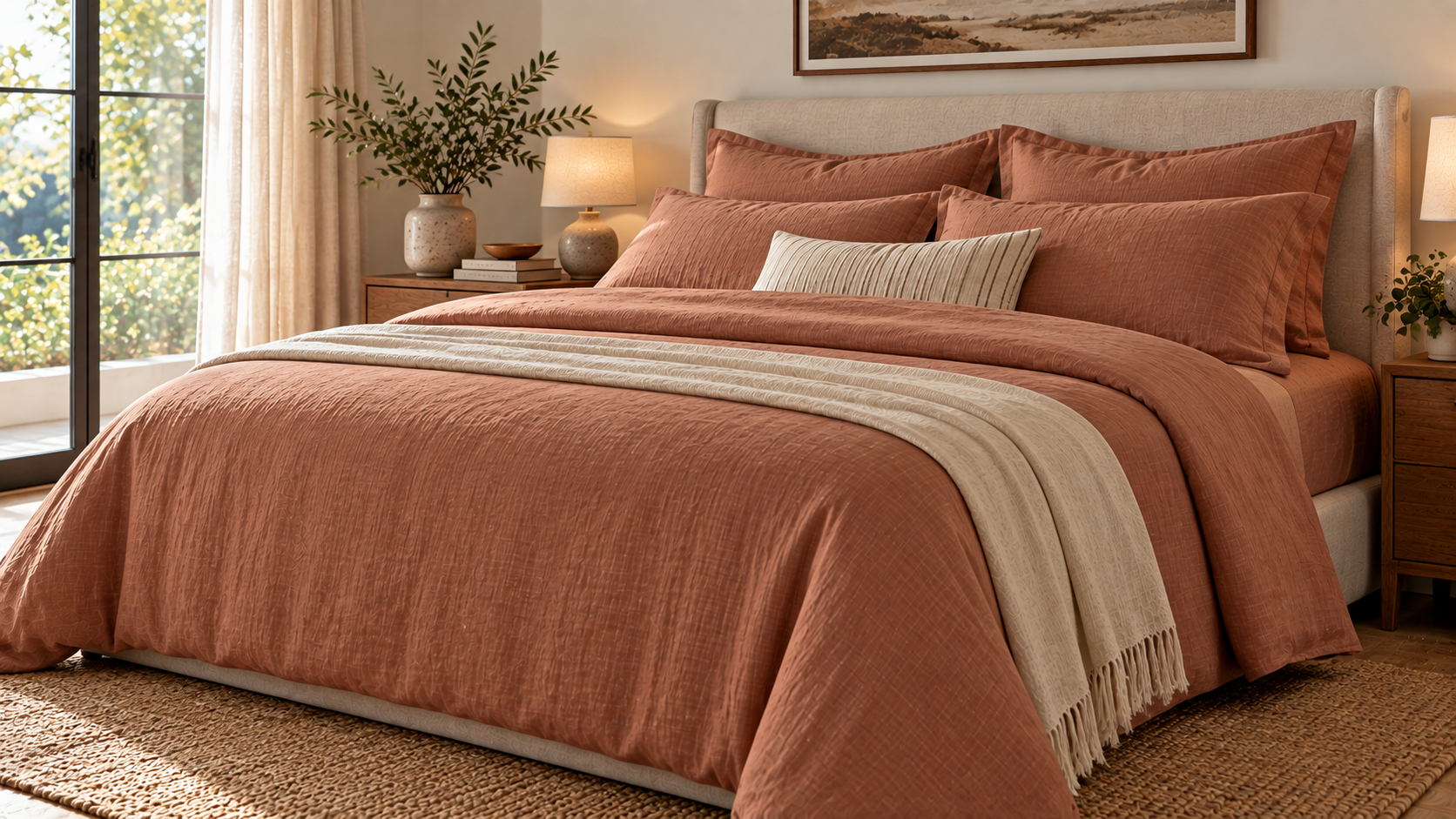
Choosing linen sheets can take a little research, especially when product pages use terms such as flax origin, garment washing, fabric weight, and textile certifications.
Linen has a noticeably different hand feel from many common bedding fabrics, so knowing what to check before buying can help you find a set that suits your sleep preferences, climate, and laundry routine.
Linen Sheets: What Should You Check Before Buying?
When comparing linen bedding, start with the fiber-content label rather than relying on product photography or marketing language.
Linen is a textile made from flax fiber, and the terms “flax” and “linen” can describe different stages: flax refers to the plant and fiber, while linen refers to the resulting textile.
A practical shopping checklist includes:
- Fiber composition
- Fitted-sheet dimensions and pocket depth
- Included pieces
- Fabric weight or construction information
- Washing and drying instructions
- Textile certifications, when available
- Return policy and warranty terms
- Replacement-piece availability
These details give you a better basis for comparing products than appearance alone.
Understanding 100% Linen Bedding
If you specifically want 100% linen sheets, read the fiber-content label carefully. Some bedding combines linen with another fiber, so a product containing linen does not necessarily mean the fabric is entirely linen.
You may also encounter certifications connected with European flax and linen production. Masters of FLAX FIBRE™, formerly European Flax™, provides verified European-origin traceability for qualifying flax-linen products.
The certification is independently audited, and certified products must meet defined composition and traceability requirements.
Masters of LINEN™ applies a separate standard covering certified European flax-linen production and processing requirements.
Certification does not automatically tell you which sheet set will feel best. It can, however, provide independently defined information about sourcing, composition, or textile testing.
Linen Versus Cotton: How Do They Differ?
Shoppers researching linen vs cotton sheets often focus on softness, texture, care, and appearance.
| Feature | Linen | Cotton |
|---|---|---|
| Source fiber | Flax | Cotton plant |
| Typical surface | Textured | Depends heavily on weave and finishing |
| Appearance | Often relaxed and lightly creased | Can range from crisp to smooth |
| Wrinkling | Common | Varies by weave and finish |
| Construction | Commonly sold by fabric weight or other specifications | Thread count is frequently listed |
| Care | Product instructions vary | Product instructions vary |
Neither fiber automatically guarantees better bedding. Fabric construction, fiber quality, finishing, fit, and manufacturing can significantly affect the finished product.
For that reason, avoid choosing sheets from fiber name alone.
Why Fabric Weight Deserves Attention
Thread count is familiar to many bedding shoppers, yet it is not always the most useful specification for linen.
Some manufacturers provide fabric weight in grams per square meter (GSM). For example, the Alliance for European Flax-Linen & Hemp lists linen fabrics by weight in its sourcing database, including a 100% flax-linen fabric specified at 165 g/m².
A number by itself still cannot tell you exactly how sheets will feel in your bedroom. Yarn characteristics, weaving, finishing, washing, and personal preference all affect the experience.
If a manufacturer publishes fabric weight, use it as one comparison point rather than treating a higher or lower figure as automatic evidence of quality.
How to Evaluate Breathable Linen Sheets
People frequently shop for breathable linen sheets when they prefer bedding that does not feel overly heavy or closely fitted against the body.
Instead of relying solely on a “breathable” product claim, look at several characteristics together:
- Fiber composition
- Fabric construction
- Fabric weight, when disclosed
- Finishing treatments
- Number of bedding layers you normally use
- Your room temperature and climate
Personal comfort varies considerably. Someone who sleeps comfortably under lightweight bedding may prefer a different construction from someone who wants heavier bedding throughout the year.
Does Pre-Washed Linen Matter?
You will often see pre-washed linen or garment-washed linen in bedding descriptions.
Pre-washing is a finishing process performed before the product reaches you. Manufacturers may use washing and finishing processes to alter the initial hand feel or appearance of the textile.
When comparing pre-washed sets, check the manufacturer’s actual care instructions. Avoid assuming that “pre-washed” means the sheets cannot shrink, change texture, or require specific laundering conditions.
The product’s care label remains the best reference for washing, drying, ironing, and temperature guidance.
Check Certifications Carefully
Certification logos can provide useful information, provided you know what each label verifies.
OEKO-TEX® STANDARD 100, for example, applies to textiles tested against specified harmful-substance criteria. OEKO-TEX states that certified articles and their components are tested against a list exceeding 1,000 substances, with requirements becoming stricter as skin contact increases.
That certification should not be interpreted as a general quality rating for softness, durability, comfort, or construction.
Similarly, Masters of FLAX FIBRE™ and Masters of LINEN™ concern defined origin, composition, production, and traceability requirements rather than serving as universal comfort ratings.
When a seller displays a certification, verify what the certification covers rather than assuming every sustainability or safety claim means the same thing.
Measure Your Mattress Before Ordering
Size labels such as Queen, King, or California King are useful starting points, yet dimensions can differ among products and markets.
Before ordering, measure:
- Mattress width
- Mattress length
- Mattress depth
- Additional height from a mattress topper or pad
Then compare those measurements with the manufacturer’s fitted-sheet specifications.
Pocket depth deserves particular attention. A fitted sheet that cannot accommodate your mattress and topper may pull away from the corners even when the stated bed size appears correct.
Flat-sheet dimensions and pillowcase sizes are worth checking too.
Look at What the Sheet Set Includes
A product called a “sheet set” does not always contain identical pieces from one retailer to another.
Depending on the seller, a package may include a fitted sheet, flat sheet, and one or two pillowcases. Other sets may omit the flat sheet or allow individual components to be purchased separately.
Check the package contents before comparing prices.
A lower-priced set may contain fewer pieces, while a higher-priced option could include components you would otherwise need to purchase separately.
Are Stonewashed Linen Sheets Different?
The term stonewashed linen sheets usually refers to linen that has undergone a washing or finishing treatment intended to influence its initial texture or appearance.
Do not treat “stonewashed” as a standardized quality grade unless the manufacturer provides specific technical information supporting that description.
When this finish interests you, compare the manufacturer’s explanation of the process, fiber composition, care directions, and return policy. Those details provide a stronger basis for evaluating the product than the finishing term alone.
Examine Construction Details
Small construction details can affect everyday usability.
Fitted Sheet
Check for elastic placement, pocket depth, and sizing information. Some designs use elastic around the entire edge, while others use different construction methods.
Pillowcases
Look at closure style and dimensions. Envelope closures can help keep pillows covered, while open-ended cases may be simpler to remove.
Seams
Product photography can help you inspect hems, stitching, and visible construction. If close-up images are unavailable, look for construction information in the specifications.
Individual Replacement Pieces
Being able to purchase one fitted sheet or pillowcase separately can be useful if one component wears sooner than the rest.
How Should You Compare Prices?
Price comparisons work best when you compare equivalent products.
Check:
- Fiber composition
- Bed size
- Number of included pieces
- Product dimensions
- Certifications
- Construction details
- Return conditions
- Warranty information
- Shipping costs
A set costing less upfront may not include the same pieces as another product.
Likewise, a higher price does not independently establish better durability or comfort. Look for specific material and construction information that explains what you are paying for.
Common Questions About Linen Bedding
Are linen sheets supposed to feel textured?
Linen can have a noticeable natural texture, although the finished feel depends on yarn, construction, washing, and other finishing processes.
Does a higher GSM automatically mean better sheets?
No. Fabric weight describes weight per unit area; it does not function as a universal quality score. Construction and finishing matter too.
Should you prioritize thread count?
Thread count alone should not drive your decision. For linen, fiber composition, fabric construction, weight information, dimensions, and finishing details can provide useful comparison points.
Are certified sheets automatically better?
A certification verifies the criteria covered by that particular standard. OEKO-TEX® STANDARD 100 addresses harmful-substance testing, while Masters of FLAX FIBRE™ and Masters of LINEN™ address defined flax-linen sourcing and traceability requirements.
Certification should therefore be evaluated according to what it actually verifies.
Finding Linen Sheets That Fit Your Priorities
Start with fiber composition and sizing. Next, compare construction, fabric weight when available, finishing methods, certifications, package contents, and care requirements. Finally, review the seller’s return and warranty policies before purchasing.
Taking those factors together gives you a practical way to compare linen sheets without relying on marketing descriptions alone.
Leave a Reply