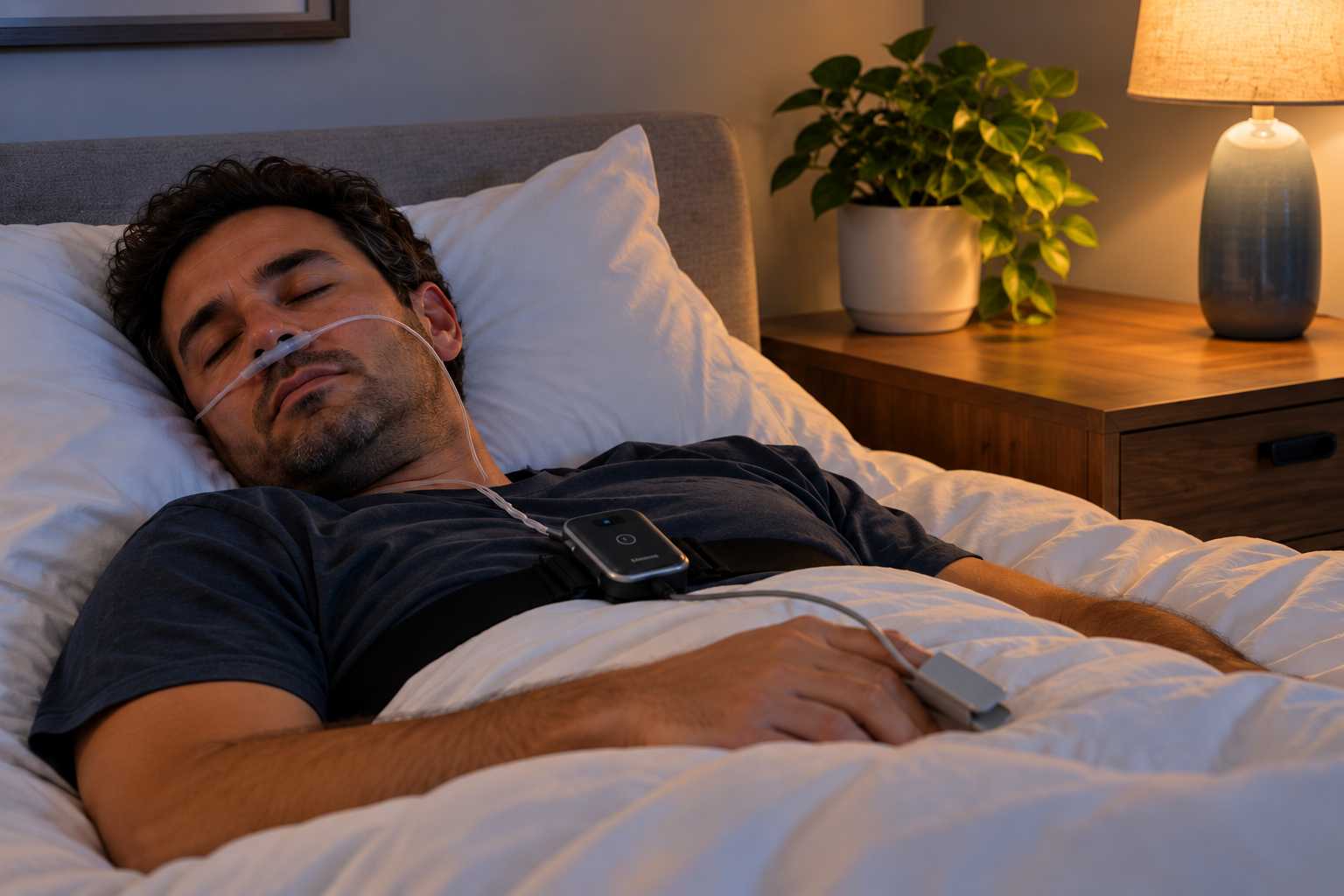
If loud snoring, nighttime gasping, or persistent daytime sleepiness has you questioning the quality of your sleep, an at-home sleep test may be one testing option worth discussing with a healthcare provider.
Instead of spending the night at a sleep center, you use portable monitoring equipment while sleeping in your own bed.
Home testing has an important limitation: it is primarily used to evaluate suspected obstructive sleep apnea (OSA), rather than diagnose every type of sleep disorder.
MedlinePlus notes that home studies use fewer sensors than laboratory studies and generally record measurements such as breathing, heart rate, blood oxygen levels, and snoring.
What Does an At-Home Sleep Test Measure?
An at-home sleep test records physiological information while you sleep at home. Depending on the equipment, measurements can include breathing rate, respiratory effort, heart rate, blood oxygen levels, and snoring.
A home sleep apnea test generally uses fewer sensors than laboratory polysomnography. A laboratory study can record additional information such as brain waves, eye movements, muscle activity, breathing, and other measurements throughout the night.
That difference matters when you’re deciding which type of testing fits your situation.
What happens during home testing?
The exact process depends on the provider and equipment. A typical process can involve receiving or picking up the equipment, following instructions for attaching its sensors, wearing the equipment overnight, removing it in the morning, and returning or transmitting the recorded information as directed.
Some FDA-cleared systems use wearable sensors and software to record and analyze physiological measurements.
The sensors and measurements vary by device, so check the specific device’s intended use rather than assuming every home test works identically.
Who May Be a Candidate for Home Testing?
Current American Academy of Sleep Medicine (AASM) guidance describes home testing as an alternative to laboratory polysomnography for uncomplicated adults with signs and symptoms indicating an increased risk of moderate-to-severe OSA.
The AASM states that the appropriateness of testing should be based on a patient’s medical history and an evaluation by a medical provider.
Common sleep apnea symptoms can include loud snoring, waking while gasping for breath, and daytime sleepiness. Symptoms alone do not establish a diagnosis.
At-Home Testing vs. Laboratory Testing
Understanding the differences can help you assess sleep apnea testing services before paying for one.
| Feature | Home testing | Laboratory study |
|---|---|---|
| Location | Your home | Sleep center or hospital |
| Primary role | Evaluating suspected OSA in appropriate patients | Evaluating OSA and other sleep disorders |
| Sensors | Generally fewer | Generally broader monitoring |
| Technician present overnight | No | Typically yes |
| Brain-wave monitoring | Not standard in typical home testing | Commonly included |
| Setup | Usually performed by the patient using supplied instructions | Sensors applied by trained staff |
Sources: MedlinePlus and AASM.
The simpler setup may make a sleep study at home practical for selected patients, but fewer measurements mean it cannot substitute for laboratory testing in every clinical situation.
When Might a Laboratory Study Be Appropriate?
AASM guidance recommends polysomnography rather than home testing for certain patients, including people with significant cardiorespiratory disease, potential respiratory muscle weakness associated with neuromuscular conditions, suspected sleep-related hypoventilation, chronic opioid medication use, a history of stroke, or severe insomnia.
Home testing also focuses primarily on OSA. MedlinePlus states that it does not diagnose other types of sleep disorders.
An overnight sleep study at a sleep center records additional signals and can help clinicians investigate a broader set of sleep problems.
What Should You Check Before Choosing a Test?
Home testing services and devices aren’t interchangeable. Before paying, check several practical details.
1. What is the test intended to detect?
Look at the stated intended use. A medical test designed to aid OSA diagnosis differs from a consumer feature that assesses possible sleep-apnea risk.
For example, the FDA distinguishes over-the-counter devices that assess sleep-apnea risk from diagnostic testing. Its device classification states that these risk-assessment products aren’t intended to provide a standalone diagnosis or replace traditional diagnostic methods.
2. Who reviews the results?
This is especially important when comparing online services.
The AASM states that diagnostic and treatment decisions should not rely solely on automatically scored home-test information and that raw HSAT data should receive appropriate physician review and interpretation.
3. What does the equipment record?
Check which measurements the sleep monitoring device actually collects.
Depending on its design, equipment may record combinations of airflow, respiratory effort, oxygen saturation, heart activity, movement, or other physiological signals.
FDA records show that currently cleared systems use different sensor configurations, reinforcing the need to review the specifications of the particular system you’re evaluating.
4. What happens if the recording fails?
Incorrect sensor placement, detached equipment, or inadequate recording time can potentially result in unusable information.
Check the provider’s procedure for technically inadequate tests before paying. AASM clinical guidance recommends laboratory polysomnography when a single home test is negative, inconclusive, or technically inadequate in a patient being evaluated for OSA.
5. What happens after testing?
Testing should lead to understandable next actions. Find out how results are delivered, who discusses them with you, and what happens if additional evaluation is needed.
Can a Smartwatch Replace an At-Home Test?
Not necessarily.
Some consumer wearables now have FDA-cleared functions that can assess the risk of sleep apnea.
However, the FDA specifically classifies these functions as risk-assessment tools rather than standalone diagnostic tools or replacements for traditional diagnostic methods such as polysomnography.
A wearable alert may give you information worth discussing with a healthcare provider, but it should not automatically be treated as equivalent to a medically directed diagnostic study.
How Should You Prepare for Testing?
Follow the instructions supplied by your healthcare provider or testing service, since requirements can differ.
MedlinePlus advises patients preparing for sleep studies to avoid alcohol and caffeine during the afternoon and evening before testing, avoid daytime naps, and avoid products such as lotions or hair gels that could interfere with electrodes.
It also advises discussing sleep medicines with your provider rather than changing them independently.
Correct sensor placement matters as well. Follow the supplied setup instructions closely and contact the provider if you’re unsure how equipment should be positioned.
What Do the Results Tell You?
Sleep-study reports can contain several measurements. One frequently used measure is the apnea-hypopnea index (AHI), which represents the number of apnea and hypopnea events per hour measured during a sleep study.
The AASM also cautions against basing diagnosis or treatment decisions solely on automatically generated HSAT results.
That makes professional interpretation an important feature to check when comparing testing services.
Questions to Ask Before Paying for an At-Home Sleep Test
Before selecting a service, ask:
- Is this intended for diagnosing suspected OSA or only assessing risk?
- Is a medical evaluation included before testing?
- Who reviews and interprets the recorded data?
- Which physiological signals does the equipment record?
- What happens if the recording is incomplete?
- How will the results be explained?
- Is follow-up available if laboratory testing is recommended?
- Are all charges clearly disclosed before purchase?
These questions can help you compare services based on clinical process and support rather than convenience alone.
When you’re ready to compare services, review the test’s intended use, monitoring features, medical-review process, and follow-up terms before choosing an at-home sleep testing option.
Is an At-Home Sleep Test Right for Your Situation?
An at-home option can play a useful role when OSA is suspected and a healthcare provider determines home testing is appropriate.
It gives selected patients a way to collect physiological information while sleeping in familiar surroundings.
Its limitations matter equally. Home testing generally records fewer signals than laboratory polysomnography, is primarily intended for evaluating OSA, and may not be appropriate when certain medical conditions or other suspected sleep disorders are present.
Focus your comparison on what the test measures, its regulatory or clinical status, who interprets the findings, and what medical support follows the recording. Those factors can tell you far more than convenience claims alone.
Leave a Reply