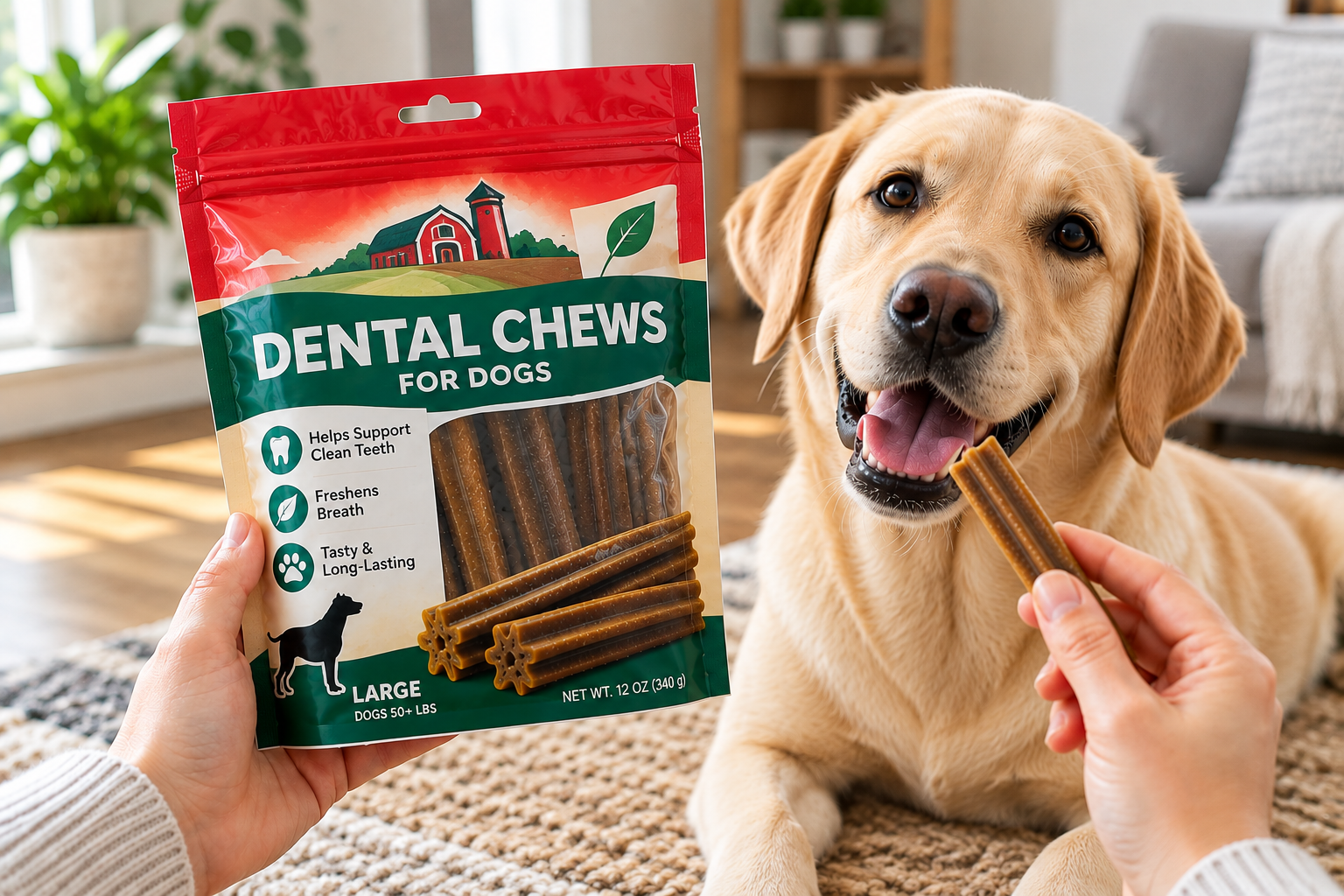
Keeping your dog’s teeth clean can be challenging, especially if brushing does not go smoothly every day.
Dental chews for dogs provide another way to support an at-home oral care routine while giving your dog something enjoyable to chew. Yet products differ in size, texture, ingredients, calorie content, and intended use, so choosing one takes some research.
What Are Dental Chews for Dogs Designed to Do?
Dental chews are edible products designed to encourage chewing and provide mechanical contact with the surfaces of a dog’s teeth. Depending on the product, manufacturers may market them as helping manage plaque, tartar, or breath.
They can form part of dog dental care, though they should not automatically replace tooth brushing or veterinary dental care.
The American Veterinary Medical Association notes that regular dental care at home and veterinary examinations are important parts of maintaining a pet’s oral health.
Product design matters as well. Shape, firmness, size, and chewing time can affect how your dog interacts with a chew, which is why comparing products by something other than package appearance can be helpful.
Dental Chews vs. Tooth Brushing
Tooth brushing and dental chews perform different roles in an oral care routine.
| Feature | Dental Chews | Tooth Brushing |
|---|---|---|
| How they work | Chewing creates mechanical contact with teeth | Brush bristles mechanically clean tooth surfaces |
| Effort for owner | Usually low | Requires regular hands-on brushing |
| Dog participation | Dog chews independently under supervision | Dog must tolerate brushing |
| Product selection | Must fit dog size and chewing behavior | Requires a pet-appropriate toothbrush and toothpaste |
| Main limitation | Does not reach every tooth surface equally | Some dogs resist brushing |
Brushing with products intended for dogs remains an important form of dog teeth cleaning. Dental chews can supplement that routine when selected appropriately.
Never use human toothpaste unless a veterinarian specifically directs you to do so. Some ingredients found in products intended for people may be unsuitable for pets.
Look for Evidence Behind Dental Claims
One useful starting point when comparing products is the Veterinary Oral Health Council (VOHC). The VOHC evaluates submitted data for products seeking its Seal of Acceptance for plaque or tartar control.
A VOHC seal does not mean a chew treats every dental problem or eliminates the need for veterinary care. Instead, it indicates that the product met the council’s requirements for the specific plaque or tartar claim listed.
If you are researching dog dental treats, checking the VOHC accepted-products list can help you identify products with supporting evidence for particular oral-health claims.
Choose the Correct Size for Your Dog
Manufacturers commonly divide dental chews into weight or size categories. Follow the individual product’s feeding directions rather than assuming that any chew labeled small, medium, or large will suit your dog.
The appropriate chew should allow your dog to chew rather than swallow it immediately. A product that is too small could potentially be swallowed in large pieces, while an unsuitable texture may be difficult for some dogs to handle.
This becomes especially important when shopping for dental chews for small dogs, since products designed for larger dogs may not have appropriate dimensions or feeding instructions for a smaller animal.
Always check:
- Recommended dog weight or size
- Minimum age stated by the manufacturer
- Feeding frequency
- Supervision instructions
- Calorie information
- Ingredient list
- Storage directions
If your dog tends to swallow treats rapidly rather than chew them, discuss suitable options with your veterinarian.
Check Texture and Chewing Style
Dogs chew differently. Some work slowly on treats, while others attempt to break them apart quickly.
A dental chew needs enough chewing action to serve its intended mechanical purpose, yet extremely hard items can present another concern.
The American Veterinary Dental College advises against chewing objects that are hard enough to potentially damage teeth.
For dogs that have difficulty handling firmer products, soft dental chews for dogs may be worth researching.
However, softer texture alone does not establish dental effectiveness. Check the manufacturer’s directions and supporting evidence for any oral-health claims.
Dogs with existing dental disease, damaged teeth, recent dental procedures, or chewing difficulties may need veterinary guidance before using dental chews.
Read the Ingredient List Before Buying
Dental chews are edible, so their ingredients matter alongside their shape and texture.
Review the complete ingredient statement if your dog has known food sensitivities or follows a veterinarian-directed diet. Do not assume that every dental product uses the same protein sources, grains, flavorings, or other ingredients.
You should also look at calorie content. Treats and chews add calories to your dog’s daily intake, and frequent extras can affect an otherwise carefully planned diet.
If you want a chew primarily for breath concerns, you may encounter products promoted as dog chews for bad breath.
Keep in mind that persistent unpleasant breath can sometimes accompany dental or other health problems. Masking the odor does not identify its cause.
How Dental Chews Compare With Other Oral-Care Products
Dental chews are only one product category available for canine oral hygiene.
Toothbrushes and Dog Toothpaste
Brushing gives you direct control over which accessible tooth surfaces are cleaned. It does require cooperation from your dog and regular participation from you.
Dental Diets
Some veterinary dental diets are specifically formulated with characteristics intended to support oral health. These are foods rather than occasional chews, so they serve a different purpose.
Water Additives
These products are added to drinking water according to manufacturer instructions. Their ingredients, evidence, and intended claims vary by product.
Dental Chews
Chews may be convenient because many dogs willingly use them. Their suitability still depends on your dog and the individual product.
What Should You Check on the Package?
Packaging can provide useful information if you know what to examine.
Start with the feeding instructions and intended dog size. Then check the ingredient statement, calorie content, warnings, age restrictions, storage instructions, and any independently recognized dental certification.
Pay close attention to exactly what a manufacturer claims. “Helps control tartar,” for example, is different from claiming that a product prevents dental disease.
You can compare dental chew sizes, ingredients, feeding directions, and current pricing before choosing an option for your dog.
Are Dental Chews Safe for Every Dog?
No single chew is suitable for every dog.
Age, body size, dental condition, dietary restrictions, medical history, and chewing behavior can affect suitability. Dogs that gulp food or chew aggressively may require added supervision or a different approach.
Chewing products can also present choking or gastrointestinal risks if large pieces are swallowed. Follow the manufacturer’s instructions and supervise your dog as directed.
Contact a veterinarian if your dog develops symptoms such as difficulty eating, bleeding from the mouth, excessive drooling, facial swelling, broken teeth, or persistent bad breath.
Can Dental Chews Replace Professional Dental Care?
Dental chews should not be treated as a substitute for veterinary dental examinations or treatment when dental disease is present.
A veterinarian can examine areas that are difficult to evaluate at home and determine if professional dental treatment is appropriate. Home care can then support the dental plan recommended for your dog.
Think of chews as one possible part of routine maintenance rather than a treatment for an established dental condition.
How Often Should Dogs Have Dental Chews?
There is no universal schedule that applies to every product.
Follow the feeding frequency listed by the manufacturer and any instructions provided by your veterinarian. Giving additional chews beyond the recommended amount can increase calorie intake and may create other problems.
If you use several treats during the day, account for their combined calories when planning your dog’s food intake.
What Makes a Dental Chew Worth Buying?
Before purchasing, ask a few practical questions:
- Is the product designed for your dog’s weight and age?
- Does its texture suit your dog’s chewing behavior?
- Are its oral-health claims supported by appropriate evidence?
- Does it have a VOHC Seal of Acceptance for the claim you care about?
- Are the ingredients compatible with your dog’s diet?
- Can its calories fit reasonably into your dog’s daily intake?
- Can your dog use it safely under the recommended supervision?
These checks make it easier to compare products based on relevant characteristics rather than marketing language alone.
Finding the Right Dental Chew for Your Dog
The right choice depends on your individual dog rather than one product being suitable for every pet. Size, chewing behavior, ingredients, calories, dental condition, and evidence supporting oral-health claims all deserve attention.
Start by reading the label carefully and checking independently recognized dental claims where available. If your dog already has dental problems, dietary restrictions, damaged teeth, or unusual chewing behavior, ask your veterinarian before introducing a new chew.
Used according to product directions and alongside appropriate veterinary and at-home dental care, dental chews can serve as one practical component of your dog’s oral hygiene routine.
Leave a Reply