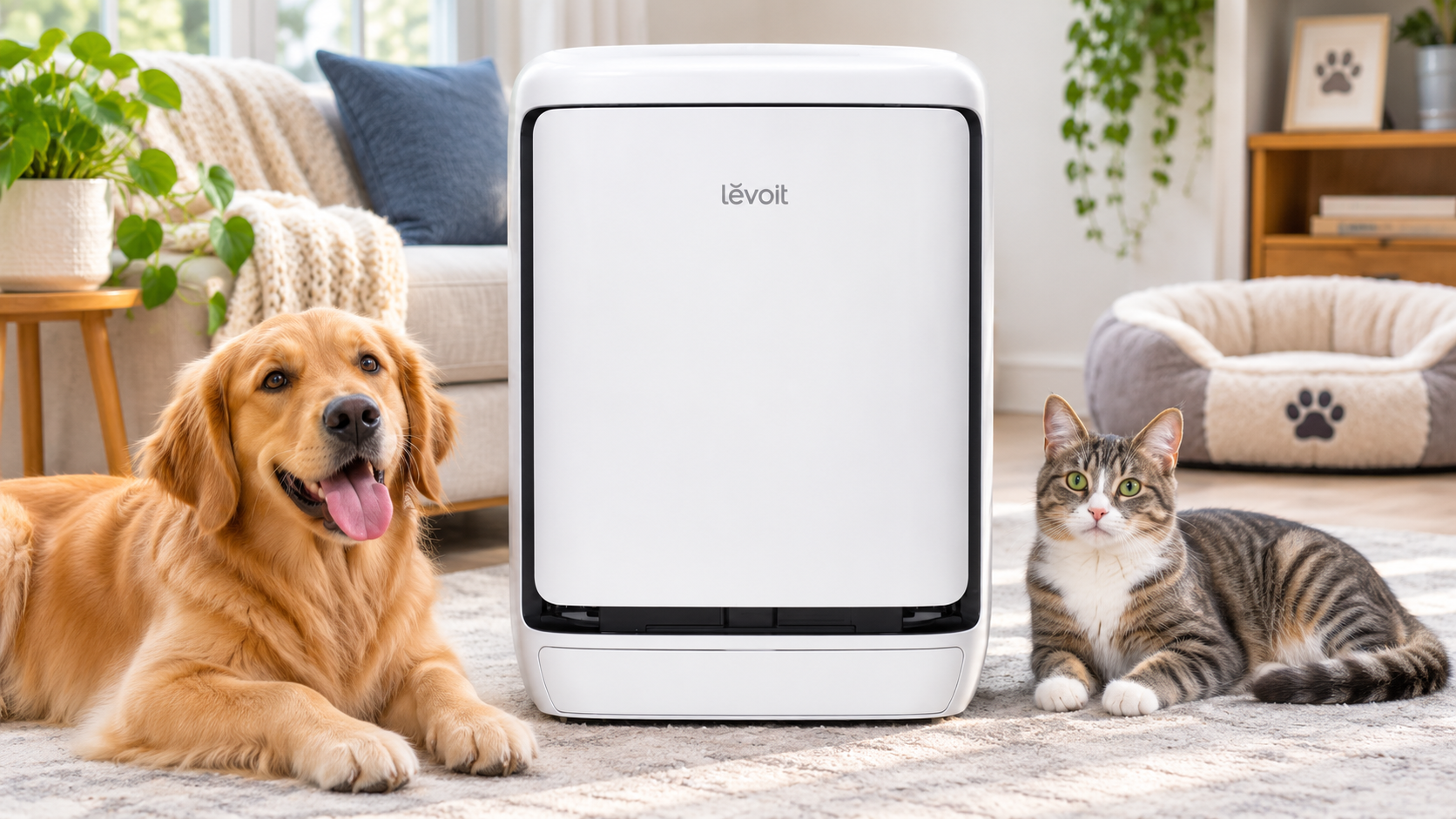
Sharing your home with dogs or cats brings plenty of enjoyable moments, although shedding, lingering odors, and airborne allergens can make indoor air quality harder to manage.
The LEVOIT Vital Pet Pro Dog & Cat Air Purifier is designed for households looking to address these everyday concerns through continuous air filtration.
If you’re searching for an air purifier that fits your pet-friendly household, understanding its filtration system, maintenance requirements, and practical limitations can help you decide if this model deserves a place in your home.
LEVOIT Vital Pet Pro Dog & Cat Air Purifier: Features and Benefits
The LEVOIT Vital Pet Pro Dog & Cat Air Purifier targets common indoor air concerns associated with living alongside pets.
Pet hair, dander, household dust, and unpleasant smells can accumulate throughout your living space.
An air purifier can help capture airborne particles while complementing regular cleaning routines.
Filtration Designed for Pet-Friendly Households
A LEVOIT pet air purifier can be a practical addition to your home if your pets frequently shed or spend time indoors.
Air purifiers generally rely on several filtration stages to manage different types of airborne contaminants.
Common filtration functions include:
- Pre-filtration: Captures larger particles such as lint, visible hair, and dust.
- Fine-particle filtration: Targets smaller airborne particles, including some pet dander and dust.
- Activated carbon filtration: Helps reduce certain household odors and gaseous pollutants.
- Continuous air circulation: Draws surrounding air through the filtration system repeatedly.
The exact filtration configuration, filter efficiency, and replacement requirements should be confirmed against the manufacturer’s specifications for the model being purchased.
Helping Manage Airborne Pet Hair
An air purifier for pet hair may help capture loose fur that becomes airborne before settling on furniture and flooring.
This can be particularly useful if your dog or cat sheds frequently.
However, air purifiers cannot collect all the hair already resting on carpets, sofas, bedding, or clothing.
For better household cleanliness, combine air filtration with:
- Regular vacuuming of floors and upholstered furniture.
- Brushing your pets according to their coat type.
- Washing pet bedding frequently.
- Cleaning the purifier’s pre-filter according to its instructions.
These habits can help limit the amount of loose hair circulating throughout your home.
Can the LEVOIT Vital Pet Pro Help Reduce Pet Odors?
Pet odors can originate from several household sources, including litter boxes, pet bedding, damp fur, and accidents.
An air purifier for pet odors equipped with suitable activated carbon filtration may help reduce certain smells circulating in the air.
However, the effectiveness depends on the amount and type of carbon used, airflow, odor concentration, and filter condition.
Common Sources of Pet Odors
Litter box areas
Cat litter boxes may produce unpleasant smells, particularly when waste remains for extended periods. Air filtration can support odor management, although regular litter removal remains necessary.
Dog bedding and sleeping areas
Pet bedding can collect fur, skin oils, and moisture. Washing these materials regularly helps address odors at their source.
Shared living spaces
Sofas, carpets, and other soft furnishings can retain pet-related smells. Cleaning these surfaces and maintaining airflow can help keep the room comfortable.
What Air Purifiers Cannot Do
Even an effective purifier cannot eliminate every household odor.
Strong smells may persist when their source remains untreated. Additionally, some gases and odors require substantial activated carbon capacity for meaningful reduction.
For dependable results, focus on removing odor sources while using filtration as a supporting measure.
Is the LEVOIT Vital Pet Pro Suitable for Dogs and Cats?
Its usefulness depends on your household layout, room dimensions, number of pets, and air-cleaning needs.
Homes With Multiple Pets
Households with several animals may experience increased shedding and airborne particles.
An appropriately sized purifier can help filter circulating particles, particularly when operated consistently.
For larger living spaces, check the manufacturer’s recommended coverage area and Clean Air Delivery Rate (CADR) before purchasing.
Apartments and Smaller Living Spaces
In apartments, odors and airborne particles may become noticeable because pets and household members share a limited area.
A properly sized purifier can help circulate and filter indoor air.
However, choosing a device that is too large for your available space may create unnecessary noise or occupy valuable floor space.
Bedrooms and Pet Sleeping Areas
If your dog or cat sleeps in your bedroom, an air purifier may help reduce some airborne particles while you rest.
Pay attention to operating noise, lighting controls, and nighttime settings when comparing models.
A quieter operating mode may be preferable for sleeping, although reduced fan speed can also reduce the amount of air filtered per hour.
LEVOIT Vital Pet Pro and Pet Dander: What Should You Expect?
A pet dander air purifier is intended to capture airborne particles associated with animals.
Pet dander consists of tiny skin flakes that animals naturally shed. Pet allergens can also be associated with saliva, urine, and particles carried on fur.
Because some allergen-bearing particles can remain suspended in indoor air, effective particle filtration may help reduce airborne exposure.
Understanding Pet Allergens
Pet-related allergies are not caused exclusively by visible hair.
Allergen-bearing particles can collect in:
- Upholstered furniture
- Carpets and rugs
- Curtains
- Mattresses and bedding
- Clothing and other fabrics
An air purifier can capture particles passing through its filters, although it cannot remove allergens already embedded in household surfaces.
Can an Air Purifier Prevent Pet Allergies?
No air purifier can guarantee the prevention or elimination of pet allergies.
For people with allergies, filtration may be one part of an allergen-reduction plan that includes cleaning, appropriate ventilation, and medical guidance when needed.
What to Check Before Buying the LEVOIT Vital Pet Pro
Before purchasing, review the product listing and technical documentation to confirm that the purifier matches your needs.
1. Room Coverage and CADR
Room coverage indicates the space a manufacturer recommends for a purifier.
However, advertised coverage figures may depend on different assumptions about how frequently the device cleans the room’s air.
CADR provides a useful way to compare particle-cleaning performance between air purifiers.
For example, a room measuring 200 square feet with an 8-foot ceiling contains approximately 1,600 cubic feet of air.
A smoke CADR of approximately 107 cubic feet per minute would theoretically provide four equivalent clean-air changes per hour under simplified conditions.
For meaningful comparisons, examine CADR values rather than relying exclusively on advertised square footage.
2. Filter Replacement Costs
Air purifiers require ongoing maintenance to maintain their intended performance.
Before purchasing, check:
- The price of compatible replacement filters.
- Manufacturer-recommended replacement intervals.
- Availability of genuine filters.
- Pre-filter cleaning instructions.
- Whether replacement filters include activated carbon.
A purifier with an affordable initial price may become expensive to maintain if its replacement filters cost significantly extra.
3. Noise Levels
Fan noise matters when placing a purifier in bedrooms, home offices, or living areas.
Check whether the manufacturer publishes operating noise levels in decibels.
Remember that quieter settings generally move less air than higher fan speeds.
4. Energy Consumption
An air purifier may operate for several hours daily.
To estimate electricity usage, multiply its power consumption in kilowatts by the number of operating hours.
For example, a hypothetical 40-watt purifier running 12 hours daily consumes:
0.04 kW × 12 hours = 0.48 kWh per day
Over 30 days, that equals approximately 14.4 kWh.
Actual consumption depends on the purifier’s rated wattage and selected fan speed.
5. Controls and Maintenance
Convenient controls can make everyday operation easier.
Depending on the specific model, features worth checking include:
- Adjustable fan speeds
- Sleep mode
- Filter replacement indicators
- Air quality monitoring
- Automatic fan adjustment
- Child or pet control locks
Do not assume every feature is included without checking the official product documentation.
How Does the LEVOIT Vital Pet Pro Compare With Other Air Purifiers?
When comparing pet-focused air purifiers, prioritize measurable performance and ongoing ownership costs.
| Buying Factor | What to Evaluate | Why It Matters |
|---|---|---|
| Particle filtration | Filter efficiency and CADR | Helps assess airborne particle removal |
| Odor control | Activated carbon quantity and design | Influences effectiveness against certain odors |
| Room coverage | CADR relative to room size | Helps determine suitable placement |
| Noise | Published decibel ratings | Important for bedrooms and shared spaces |
| Maintenance | Filter price and replacement schedule | Affects long-term spending |
| Energy efficiency | Rated power consumption | Influences electricity costs |
| Convenience | Controls and monitoring features | Affects everyday operation |
A higher-priced model may be worthwhile if it provides substantially better particle-cleaning performance, quieter operation, or lower maintenance costs.
However, price alone does not establish filtration quality.
Where Should You Place Your LEVOIT Air Purifier?
Proper placement can influence how effectively an air purifier circulates air.
For practical everyday use:
- Place the purifier on a stable, level surface.
- Keep its air intake and outlet openings unobstructed.
- Avoid placing it directly behind large furniture.
- Follow the manufacturer’s minimum clearance recommendations.
- Keep the power cord away from areas where pets might chew or pull it.
- Position the device in the room where filtration is needed most.
For homes with several rooms, one purifier may not adequately clean the air throughout the entire property.
Separate devices may be necessary for spaces divided by closed doors or long hallways.
How Much Does the LEVOIT Vital Pet Pro Cost?
The selling price may vary by retailer, location, promotional availability, and product configuration.
Before placing an order, compare the current listing price with the cost of replacement filters and any shipping charges.
A practical purchasing budget should account for both the initial device and its ongoing maintenance.
For example, a hypothetical purifier costing $180 with replacement filters priced at $35 each would have a first-year equipment and filter cost of $250 if two replacement filters were required.
This example is illustrative and does not represent a verified price or replacement schedule for the LEVOIT Vital Pet Pro.
Check the current retailer listing for actual pricing.
Is the LEVOIT Vital Pet Pro Dog & Cat Air Purifier Worth Buying?
The LEVOIT Vital Pet Pro Dog & Cat Air Purifier may be worth evaluating if you’re looking for a dedicated air-cleaning device for a pet-friendly household.
Its potential value depends on verified filtration performance, room coverage, odor-control capability, operating noise, and ongoing filter expenses.
For homes with frequent shedding, an appropriately sized purifier may help capture airborne particles alongside regular vacuuming and grooming.
If unpleasant odors are your primary concern, pay particular attention to activated carbon filtration and continue addressing odor sources directly.
Before buying, confirm the exact model specifications, current selling price, and replacement filter availability.
Leave a Reply