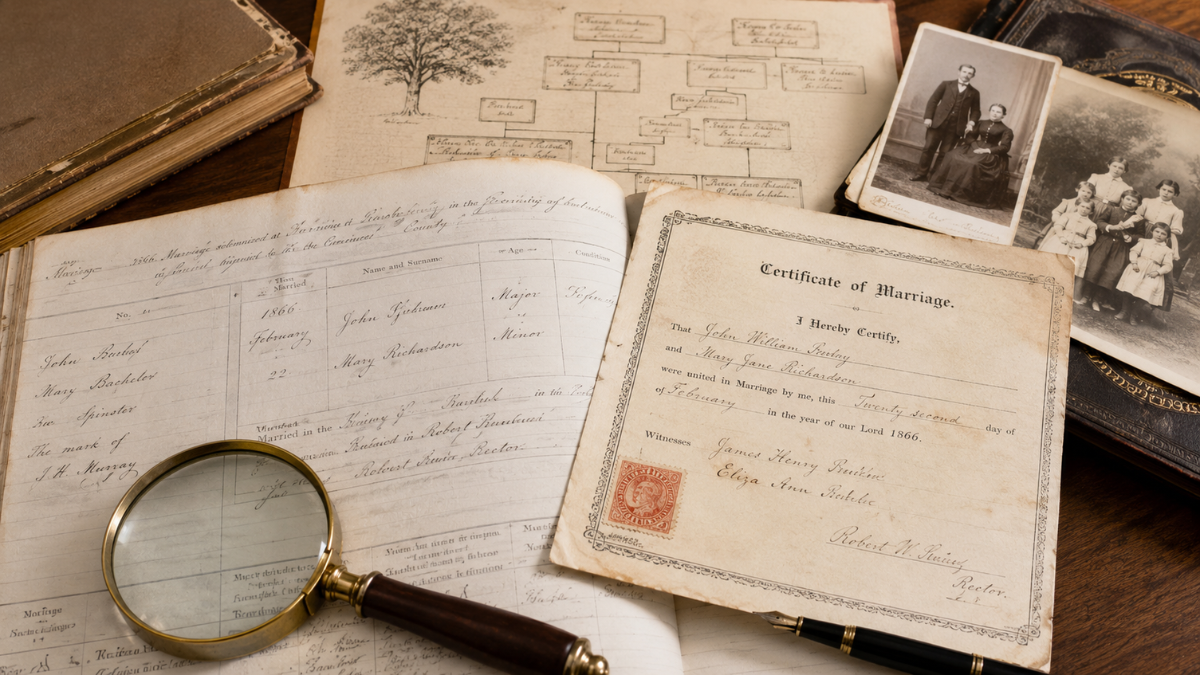
Family history often hides in the smallest details, and a marriage record can connect more dots than you might expect.
Using marriage records for genealogy may help you identify relatives, confirm family relationships, uncover maiden names, and discover places where your ancestors once lived.
These records can also provide valuable clues that lead you to birth certificates, census records, church documents, and other historical sources.
If you are building a family tree, marriage records may give you a clearer view of how different branches of your family connect.
What Are Marriage Records for Genealogy?
Marriage records are historical documents created when two people marry. Depending on the location and time period, these records may be kept by government offices, churches, courts, or local archives.
For genealogy research, marriage records can be useful because they often connect two families in a single document. A record may identify the bride and groom while also listing parents, witnesses, residences, occupations, and other personal details.
The amount of information available varies widely. Older records may include only names and a marriage date, while more detailed documents may provide several generations of useful clues.
What Information Can Marriage Records Include?
The exact details depend on the record type, year, and jurisdiction. Common information may include:
- Full names of the bride and groom
- Marriage date
- Marriage location
- Ages or birth dates
- Birthplaces
- Current residences
- Occupations
- Parents’ names
- Maiden names
- Previous marital status
- Witnesses
- Officiant’s name
- Religious affiliation
Some records may also include signatures, which can help you compare identities across other historical documents.
Why Marriage Records Matter in Genealogy Research
Marriage records can serve as important connecting points in your family tree.
They May Reveal Maiden Names
One of the biggest challenges in genealogy is tracing female ancestors whose surnames changed after marriage. Marriage certificates and licenses may reveal a bride’s maiden name, helping you continue researching her family line.
They Can Confirm Family Relationships
A marriage record may list the names of parents, allowing you to confirm connections between generations.
This can be especially helpful when several people in the same town share similar names.
They May Identify New Locations
Marriage records often include the residence or birthplace of one or both spouses. These details can point you toward additional archives, census records, property documents, or church registers.
They Can Provide Approximate Birth Information
If a marriage record lists an individual’s age, you may be able to estimate a birth year.
For example, if someone was recorded as age 25 at a marriage in 1910, you could begin searching birth records around 1884 or 1885.
Types of Marriage Records You May Find
Not every marriage document contains the same information. Understanding the different types can help you know what to search for.
| Record Type | Information You May Find |
|---|---|
| Marriage license | Names, ages, residences, parents, planned marriage details |
| Marriage certificate | Names, date, location, officiant, witnesses |
| Marriage register | Basic marriage information recorded by a church or government office |
| Marriage banns | Public announcement of an intended marriage |
| Church marriage record | Names, dates, witnesses, religious information |
| Marriage index | Names, year, location, and reference numbers |
Indexes usually provide less detail than original records, but they can help you locate the full document.
How to Find Marriage Records for Genealogy Online
Searching online can make genealogy research faster, especially when records have been digitized.
Start With Basic Family Information
Before searching, collect as much information as you already know, such as:
- Full names
- Approximate marriage year
- City, county, or state
- Names of children
- Approximate birth dates
Even one additional detail can help narrow a large set of search results.
Search Using Name Variations
Historical records often contain spelling differences.
Try searching:
- Alternate surname spellings
- Nicknames
- Initials
- Maiden names
- Common transcription errors
For example, a surname may have been spelled differently by a clerk or later misread during digitization.
Search a Range of Years
Family stories and later records may give incorrect marriage dates.
Instead of searching only one year, consider checking several years before and after the estimated date.
Search Nearby Locations
Couples did not always marry in the town where they lived.
You may need to search:
- Nearby counties
- Neighboring states
- Religious communities
- Larger towns with courthouses
Geographic flexibility can uncover records that would otherwise be missed.
How to Use Marriage Records With Other Genealogy Sources
Marriage documents become even more useful when you compare them with other historical records.
Census Records
Census records may show a married couple living together with their children, relatives, or household members.
Birth Records
A marriage record that identifies parents may guide you toward a birth certificate or baptism record.
Death Records
Death certificates and obituaries may confirm a spouse’s name, maiden name, or parents.
Church Records
Church archives may include marriages, baptisms, confirmations, and burials connected to the same family.
Newspapers
Wedding announcements may provide information not included in official marriage records, such as relatives, wedding locations, occupations, and social connections.
What If You Cannot Find a Marriage Record?
A missing record does not always mean a marriage never occurred.
Several possibilities may explain the absence.
The record may have been:
- Lost or destroyed
- Filed under a different spelling
- Recorded in another county
- Kept by a church instead of the government
- Never digitized
- Indexed incorrectly
You may also want to search indirect evidence.
For example, children’s birth records may identify both parents, while census records may help estimate when a marriage happened.
Tips for Confirming You Found the Right Couple
Finding matching names is not enough to prove a family connection.
Compare several details before adding the information to your family tree.
Look at:
- Ages
- Locations
- Occupations
- Parents’ names
- Witnesses
- Children’s names
- Birthplaces
The stronger the match across multiple records, the more confidence you may have in your conclusion.
Pay Attention to Marriage Witnesses
Witnesses can be surprisingly useful in genealogy research.
A witness might be:
- A sibling
- A parent
- A cousin
- A close family friend
- A neighbor
If you do not recognize a witness’s name, research that person. You may discover another branch of the family.
This type of cluster research can help when direct records are limited.
Keep Copies and Record Your Sources
Genealogy research becomes difficult when you forget where information came from.
For each marriage record, note:
- Record title
- Names listed
- Date
- Location
- Archive or database
- Page or certificate number
- Website or collection name
- Date accessed
Saving an image or transcription may also help you review the record later.
Common Mistakes to Avoid When Researching Marriage Records
A few simple mistakes can send family research in the wrong direction.
Assuming Every Name Is Spelled Correctly
Spelling was not always standardized, especially in older records.
Treating an Index as the Original Record
An index is helpful, but the original marriage document may contain much more information.
Ignoring Second Marriages
Widowed or divorced ancestors may have married more than once.
A later marriage record could contain valuable family details missing from an earlier one.
Accepting Online Family Trees Without Verification
Online trees can provide clues, but information should be compared with original or reliable historical records whenever possible.
Frequently Asked Questions About Marriage Records for Genealogy
Can marriage records help you find a woman’s maiden name?
Yes. Many marriage licenses, certificates, and church records may include a bride’s maiden surname, making them valuable for tracing maternal family lines.
How far back do marriage records go?
Availability varies by country, state, county, and religious institution. Some church marriage registers may date back several centuries, while civil registration may have started later.
Are marriage records always available online?
No. Many records have been digitized, but others remain available only through archives, courthouses, libraries, churches, or local government offices.
What should you do if two couples have the same names?
Compare ages, residences, occupations, parents, witnesses, and later census records before deciding which marriage record belongs to your ancestor.
Can witnesses help with genealogy?
Yes. Witnesses were often relatives or close family connections, so their names may provide additional clues about your family network.
Building a Stronger Family Tree With Marriage Records
Using marriage records for genealogy can help you connect generations, uncover maiden names, identify parents, and discover new places connected to your ancestors.
A single marriage document may lead to several other valuable sources, including census records, birth certificates, newspapers, and church registers.
The best results usually come from comparing multiple records rather than relying on one document alone. Keep track of your sources, search name variations, and examine every detail carefully.
With patient research, marriage records may become one of the most useful tools for building a more complete and accurate family history.
Leave a Reply