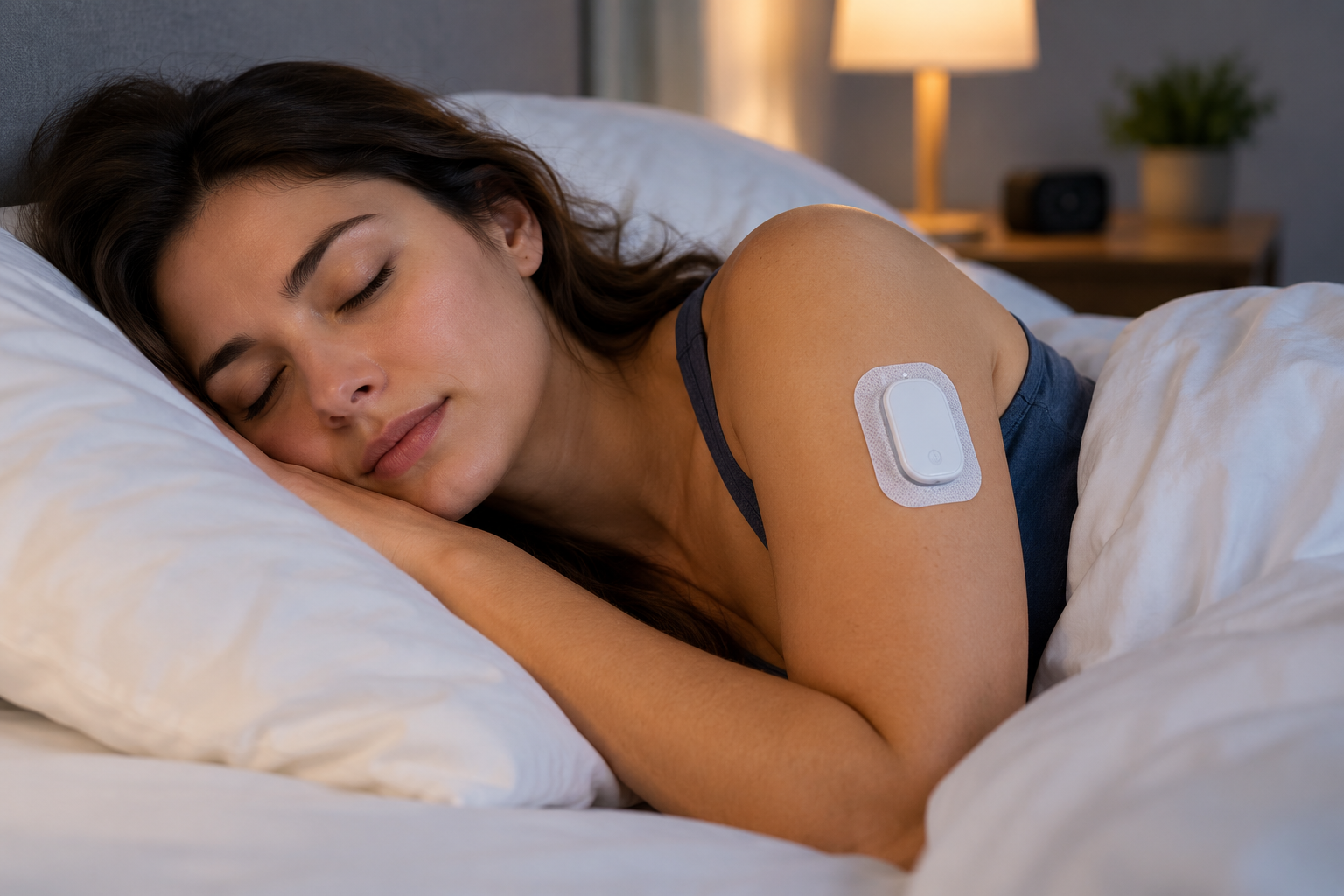
A sleep tracking patch gives you another way to collect overnight sleep data without wearing a watch or ring. Depending on the specific device, a patch may use sensors placed against the skin to record physiological signals that software then analyzes.
If you are comparing a patch with another wearable sleep tracker, focus on what it actually measures, how its results have been validated, how comfortable the adhesive is, and what happens to your data. Those details can tell you far more than a long feature list.
How Does a Sleep Tracking Patch Work?
There is no single sensor configuration shared by every sleep tracking patch.
Research into patch-based sleep technology includes systems capable of recording signals such as electroencephalography (EEG), electrooculography (EOG), and electromyography (EMG). Some experimental systems transmit collected information wirelessly for software analysis.
Consumer devices can operate differently. Many consumer wearables estimate sleep from signals such as movement or heart-related measurements rather than directly measuring the full set of physiological signals recorded during polysomnography.
That distinction matters when comparing products. Before buying, check the manufacturer’s documentation to see which sensors are present rather than assuming every patch measures the same information.
What Can a Patch Potentially Track?
Depending on its sensors and intended purpose, a patch may provide information related to:
- sleep and wake periods
- overnight movement
- estimated sleep duration
- estimated sleep stages
- physiological signals collected by its sensors
- nighttime patterns across one or several recording periods
A feature appearing in one patch does not mean it appears in every product. Verify each measurement on the manufacturer’s specifications page.
Sleep Tracking Patch vs. Other Sleep Tracking Devices
Your preferred form factor can affect how consistently you use a tracker.
| Type | How It Is Used | Main Buying Question |
|---|---|---|
| Patch | Attaches directly to the skin | Is the adhesive comfortable overnight? |
| Watch | Worn around the wrist | Can you comfortably sleep with it? |
| Ring | Worn on a finger | Does the sizing remain comfortable overnight? |
| Contactless tracker | Positioned near the bed or sleeping area | Does placement suit your bedroom setup? |
| Clinical sleep study | Uses clinical monitoring equipment | Has a clinician recommended testing? |
Studies comparing consumer trackers with polysomnography have found considerable differences among devices and measurements.
A 2025 study involving six wrist-worn trackers found high sensitivity for detecting sleep but substantially lower specificity for identifying wakefulness.
That makes published validation data worth checking when comparing a patch with another sleep monitoring device.
6 Features to Check Before Buying a Sleep Tracking Patch
1. Sensors and Measurements
Start with the sensors rather than the number of metrics displayed by the accompanying software.
Find out what the hardware directly records and which results are estimates generated by algorithms. A displayed sleep-stage graph, for instance, does not mean the device measures sleep stages in the same way as laboratory polysomnography.
2. Independent Validation
Manufacturer testing can provide useful information, yet independent comparison against established measurement methods provides additional context.
Polysomnography remains the reference method commonly used in validation research.
A 2025 meta-analysis covering 24 studies and 798 participants found statistically significant differences between wrist-worn consumer trackers and polysomnography for measurements including total sleep time, sleep efficiency, sleep latency, and wake after sleep onset.
For a particular patch, look for published research involving that exact model rather than relying on studies of unrelated wearables.
3. Adhesive and Overnight Comfort
A patch has to maintain suitable skin contact while you sleep. Check the manufacturer’s instructions concerning:
- recommended placement
- skin preparation
- single-use versus reusable components
- wear duration
- adhesive replacement
- cleaning instructions
- precautions concerning irritated or sensitive skin
Comfort deserves extra attention if you expect to collect data across several nights.
4. App and Data Presentation
An attractive graph can be easy to read, yet usefulness depends on what the numbers actually represent.
A good sleep tracking app should clearly identify its measurements, explain how nightly information is presented, and make longer-term patterns easy to review. Check device compatibility and account requirements before paying.
You may also want to see if you can export or share your records, especially if you plan to discuss them with a healthcare professional.
5. Privacy and Data Handling
Sleep trackers can collect personal physiological and behavioral information. Read the company’s current privacy policy to learn what information is stored, how long it is retained, and if information is shared with third parties.
Check what happens to your records if you close your account, too.
6. Total Ownership Requirements
Do not assess a tracker from its initial purchase cost alone. Check if the system requires replacement adhesive patches, disposable sensors, subscriptions, paid reports, or another recurring component.
Because these costs depend on the individual product and can change, current manufacturer pricing is the appropriate source.
CTA: Before purchasing, check the current product specifications and pricing from the manufacturer so you can confirm sensors, compatibility, recurring requirements, and included services.
How Accurate Are Sleep Tracking Patches?
Accuracy depends on the particular device, sensor configuration, algorithm, placement, and measurement being evaluated.
Research involving consumer sleep technology shows why you should avoid treating every measurement equally.
A recent review of real-life consumer sleep-device studies found that these technologies were generally better suited to estimating basic measures such as sleep duration and timing than measurements involving sleep stages or sleep fragmentation.
An earlier review likewise found that consumer devices could overestimate total sleep time and sleep efficiency while underestimating sleep disruptions.
Patch-based technology can use different sensors from wrist devices, so wrist-tracker research cannot establish the accuracy of a particular patch. Product-specific validation remains important.
Can a Sleep Tracking Patch Measure Sleep Stages?
Some systems provide sleep stage tracking, although the way those stages are estimated depends heavily on their sensors and algorithms.
Laboratory polysomnography records several physiological signals used to classify sleep. Consumer trackers typically work with fewer signals, which means their stage estimates should not automatically be treated as equivalent to laboratory measurements.
In a 2025 validation study of six wrist-worn devices, agreement with polysomnography for sleep-stage classification ranged from fair to moderate.
If sleep stages are one of your main reasons for buying a patch, search for independent validation of that exact device and feature.
Can You Use a Patch to Monitor Sleep Quality?
A sleep quality monitor can help you observe recurring patterns, particularly when the device records information consistently across multiple nights.
For example, you might compare your estimated sleep timing or duration across workdays and weekends. The tracker can then function as a record of patterns rather than a single-night verdict on how well you slept.
Consumer sleep technology can potentially support conversations between patients and clinicians when used alongside an appropriate clinical evaluation.
Is a Sleep Tracking Patch the Same as an At-Home Sleep Test?
Not necessarily.
A consumer tracker intended for general wellness should not automatically be treated as a medical diagnostic test.
The American Academy of Sleep Medicine has stated that consumer sleep technology without appropriate validation and regulatory clearance should not be used to diagnose or treat sleep disorders.
Some patch-based systems are being developed specifically for clinical or research monitoring. Research has demonstrated wearable patches capable of recording EEG, EOG, and EMG signals for home sleep assessment.
Always check the intended use and regulatory status of the exact product.
When Is a Sleep Tracking Patch Worth Considering?
A patch may suit you if you prefer skin-mounted technology rather than sleeping with something around your wrist or finger.
Before purchasing, ask:
- What signals does the patch directly measure?
- Which measurements are algorithm-generated estimates?
- Has the exact device been independently validated?
- How many nights can you use it?
- Are any components disposable?
- Does the system require a subscription?
- Can you export your data?
- What phones or operating systems does the app support?
- What does the privacy policy say about your data?
- Is it marketed for wellness monitoring or a regulated medical purpose?
These questions make comparisons easier because they focus on measurable product differences rather than marketing terminology.
Frequently Asked Questions
Does a sleep tracking patch diagnose sleep disorders?
Do not assume that it does. Consumer sleep technologies should not be treated as diagnostic substitutes for appropriate clinical testing unless the particular device has the relevant regulatory authorization and intended medical use.
Is a patch better than a smartwatch for sleep tracking?
Neither form factor is automatically superior. Sensor technology, validation, algorithms, comfort, and intended use differ between products. Compare specific devices rather than product categories alone.
Are sleep-stage estimates completely accurate?
No consumer tracker should automatically be assumed to reproduce laboratory sleep staging. Published studies continue to show measurement differences between consumer wearables and polysomnography.
Can nightly tracking help identify patterns?
It can provide records that may help you observe changes in measurements such as sleep timing and duration.
A 2026 rapid review found consumer sleep technology potentially useful for general monitoring of duration and circadian timing while reporting limitations for stage classification and sleep fragmentation.
Key Factors to Review Before Buying a Sleep Tracking Patch
A sleep tracking patch can be a practical option when you want overnight tracking in a skin-mounted format.
The purchasing decision should depend on the exact sensors, independent validation, adhesive requirements, software, privacy terms, recurring costs, and intended use.
Pay particular attention to the difference between wellness information and medical assessment. If a product makes diagnostic claims, check its regulatory status and supporting evidence rather than assuming that detailed charts indicate clinical accuracy.
For general tracking, focus on trends that the device can reliably measure. If you are concerned about persistent sleep problems or possible sleep-disordered breathing, tracker data can provide context to discuss with a qualified healthcare professional, rather than replacing clinical evaluation.
Leave a Reply