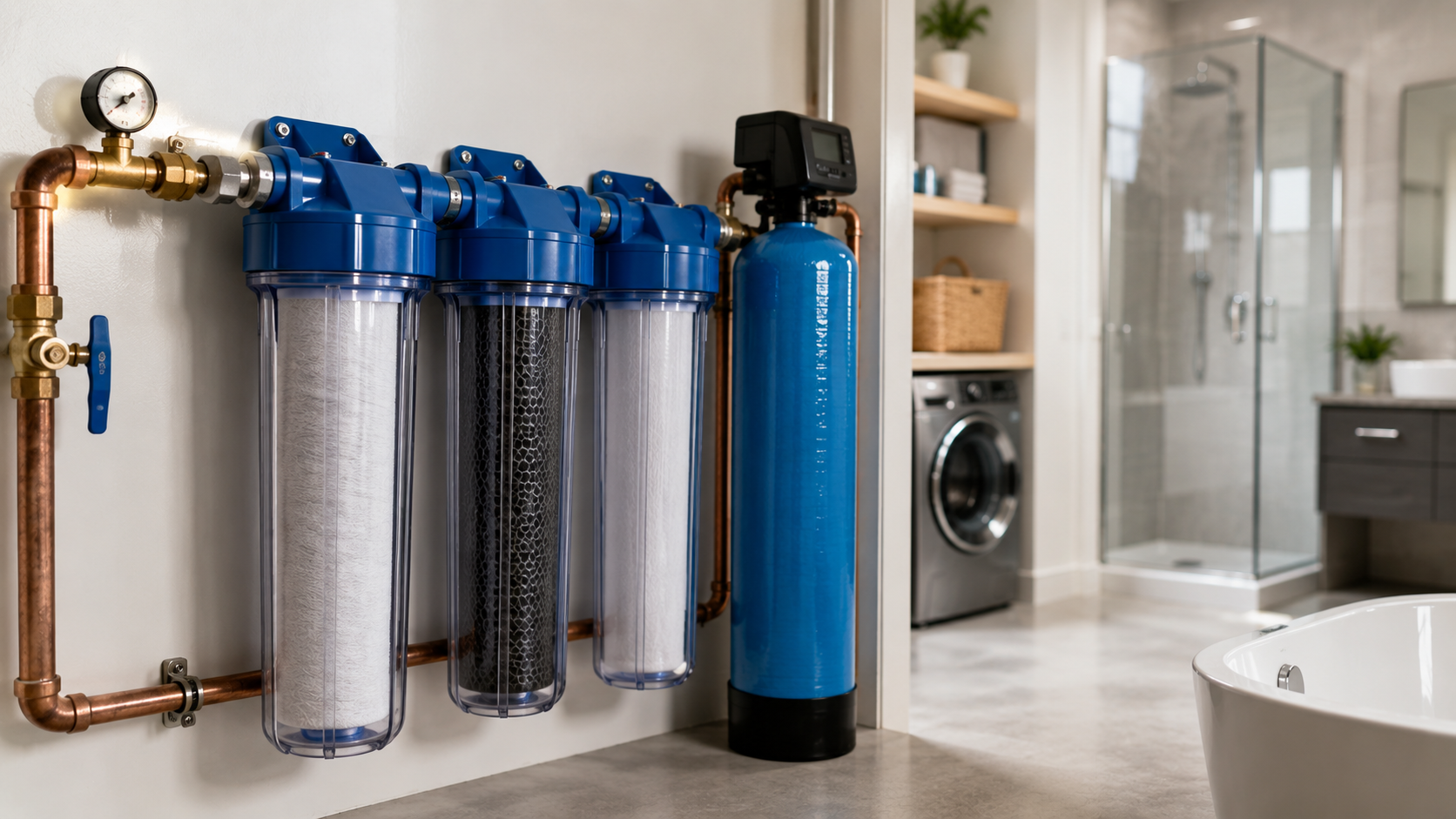
A whole-house water filtration system treats water before it travels to faucets, showers, appliances, and other fixtures throughout your home.
Unlike a filter installed at a single sink, this point-of-entry filtration system connects to the main water supply. Incoming water passes through one or more treatment stages before being distributed throughout the property.
The result is a centralized approach to improving water quality for drinking, cooking, bathing, laundry, and everyday cleaning.
How Whole-House Water Filtration Works
The exact filtration process depends on the system and the water-quality problems it is designed to address.
Many systems use multiple stages because one type of filter cannot necessarily handle every water concern.
Sediment Pre-Filtration
Sediment filtration is commonly the first stage.
This filter captures larger particles such as:
- Sand
- Dirt
- Silt
- Rust
Removing these particles early helps prevent them from reaching fixtures and appliances. It can also protect later filtration stages from becoming clogged prematurely.
Activated Carbon Filtration
Water may then pass through activated carbon.
Carbon filtration can reduce chlorine and certain compounds responsible for unpleasant tastes and odors. This can make household water more enjoyable for drinking and cooking.
Performance varies depending on the carbon media and filter design. Checking what a specific system is designed and certified to reduce is therefore important.
Specialized Water Treatment
Some homes have water-quality concerns that require additional treatment.
A whole-house system can incorporate specialized filtration media or technologies based on the contaminants identified in the water supply.
This flexibility is especially useful because municipal and private well water can present very different treatment requirements.
Filtered Water Reaches the Entire Home
After treatment, water continues through your home’s plumbing as usual.
That means filtered water can reach:
- Kitchen faucets
- Bathroom sinks
- Showers and bathtubs
- Washing machines
- Dishwashers
- Other connected fixtures
This broad coverage is one of the biggest differences between whole-house filtration and point-of-use systems.
What Are the Benefits of Whole-House Water Filtration?
The benefits depend heavily on your existing water quality and the filtration technology selected.
Better Taste and Odor
A properly selected system can reduce substances contributing to undesirable tastes and smells.
This benefit extends beyond drinking water. Better-tasting water can also make a difference when preparing coffee, tea, soups, and other foods.
Cleaner-Looking Water
Sediment filtration can capture rust, dirt, and other suspended particles before they circulate throughout the home.
Reducing these particles may produce clearer-looking water while helping limit sediment accumulation around fixtures.
Filtration Beyond the Kitchen
A countertop or under-sink filter treats water only at its installation point.
Whole-house filtration treats incoming water centrally. This means showers, laundry, cleaning, and water-using appliances can benefit alongside drinking and cooking water.
One Centralized System
Instead of installing and maintaining several individual filters, homeowners can treat incoming water from one central location.
Maintenance still matters, but the centralized setup can simplify household water treatment.
Whole-House Water Filter vs. Water Softener
A whole-house filter and a water softener are not the same thing.
Filtration systems generally target specific contaminants or water-quality concerns, such as sediment, chlorine, taste, and odor.
Water softeners primarily address hardness minerals such as calcium and magnesium.
This distinction matters if you’re dealing with scale around faucets, showerheads, or appliances. A standard filter may improve other aspects of water quality without solving the underlying hardness problem.
Some households may benefit from filtration, some from softening, and others from both.
How Do You Choose the Right System?
Start with water testing rather than choosing equipment based solely on advertising or assumptions.
Testing helps identify what is actually present in your water and gives you a clearer idea of which treatment technologies may be appropriate.
When comparing systems, consider:
- Water source
- Identified contaminants
- Household water consumption
- Required flow rate
- Filter capacity
- Relevant certifications
- Replacement filter costs
- Maintenance requirements
Flow rate deserves particular attention with whole-house systems. The equipment needs to supply enough treated water for multiple fixtures without creating unacceptable pressure or performance problems.
Is Whole-House Filtration Worth It?
A whole-house filtration system can make sense when water-quality concerns affect multiple areas of your home rather than just drinking water.
Its main advantage is comprehensive treatment. Instead of filtering a single faucet, the system treats incoming water before it reaches your plumbing fixtures and appliances.
However, the best system is not necessarily the one with the most filtration stages. It is the one designed to address the specific issues identified in your water.
Start with testing, determine whether you’re dealing with sediment, hardness, taste and odor concerns, or other contaminants, and choose treatment technology accordingly. This targeted approach can deliver better results while avoiding equipment you may not actually need
Leave a Reply