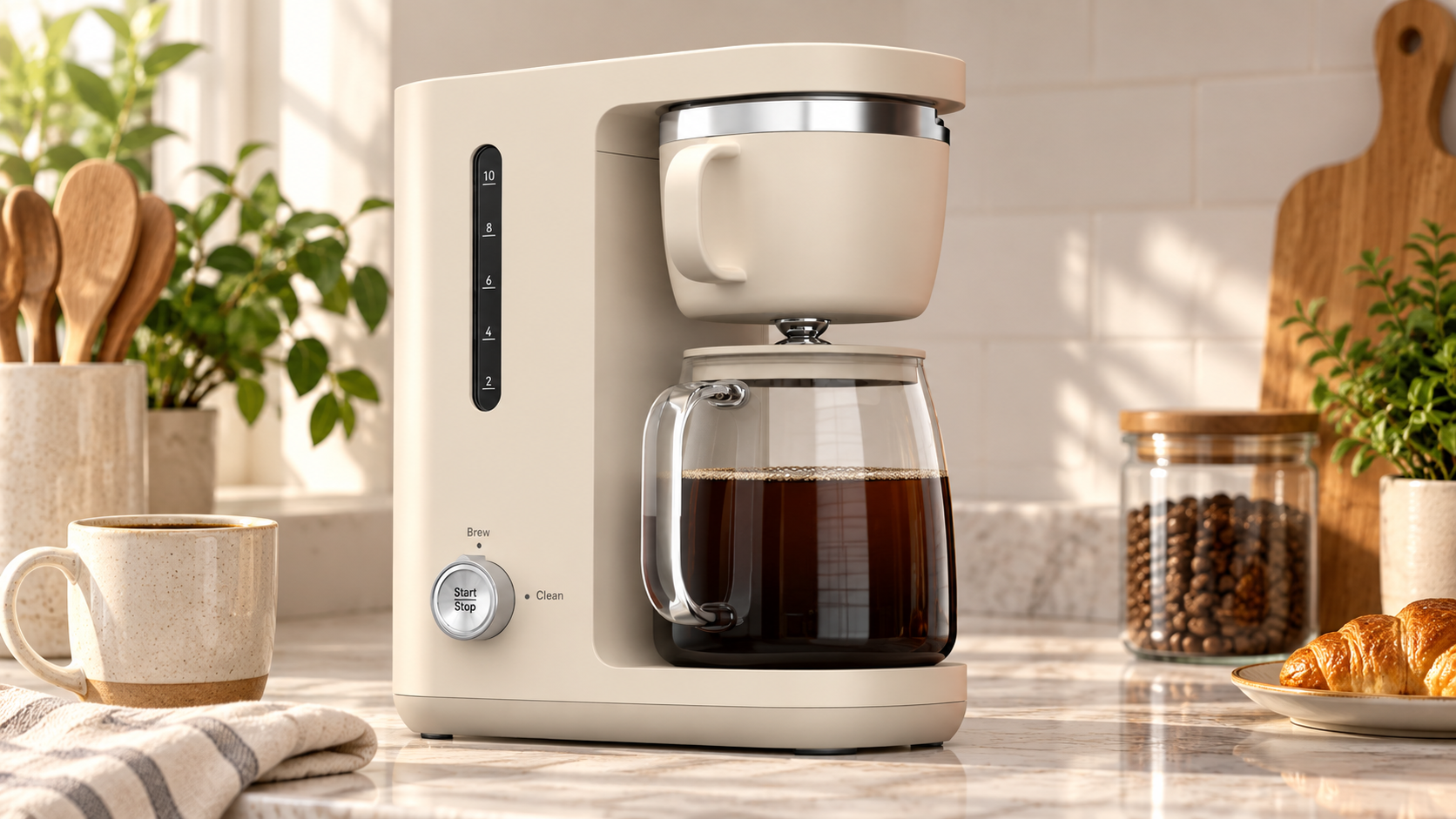
A 10-Cup Coffee Maker can make sense when you regularly brew several servings at once but do not need an oversized machine taking up counter space.
It can suit a family, shared kitchen, home office, or anyone who drinks several cups throughout the morning.
The category ranges from straightforward drip coffee maker models to machines with timers, adjustable brew strength, insulated carafes, built-in grinders, and connected controls.
Prices can differ significantly, so knowing which features you will actually use can help you avoid paying for extras that add little value to your routine.
What Should You Look for in a 10-Cup Coffee Maker?
Start with how you normally prepare and drink coffee. Capacity matters, but carafe design, programmability, cleaning requirements, brewing controls, and physical dimensions can have an equally large effect on daily use.
One detail deserves attention before buying: a manufacturer’s “cup” may be smaller than a standard drinking mug.
For example, Cuisinart states that a cup for its Personal Brew 10-Cup Thermal model is approximately 5 ounces, giving its removable reservoir a 52-ounce capacity.
That means checking the stated capacity in ounces or liters can give you a clearer idea of how much coffee a machine actually produces.
Features Worth Comparing
| Feature | Why It Matters | Best Suited For |
|---|---|---|
| Programmable timer | Starts brewing at a preset time | Busy mornings |
| Thermal carafe | Retains heat without relying solely on a warming plate | Slow coffee drinkers |
| Brew-strength control | Changes how strong the finished coffee tastes | Households with different preferences |
| Pause function | Lets you pour before brewing finishes | Anyone in a hurry |
| Removable reservoir | Makes filling and cleaning easier | Frequent brewing |
| Reusable filter | Can reduce dependence on disposable paper filters | Regular daily use |
| Automatic shutoff | Turns the machine off automatically | Convenience and peace of mind |
| Built-in grinder | Grinds beans immediately before brewing | Buyers who prefer whole beans |
You do not necessarily need every feature. A simpler brewer may be a smarter purchase when your main priorities are dependable brewing and easy cleanup.
Glass Carafe or Thermal Carafe?
Carafe type is one of the biggest purchasing decisions.
A glass carafe usually sits on a warming plate that keeps the brewed coffee heated. You can see how much coffee remains, and glass models are common across different price ranges.
A thermal coffee maker, by comparison, uses an insulated carafe designed to retain heat.
This can suit you if a pot tends to sit for an extended period before you finish it.
For example, the current GE Profile Smart Grind and Brew uses a double-walled insulated 10-cup carafe. GE lists its carafe capacity at 45 ounces and states that it is designed to keep coffee hot for up to two hours.
Cuisinart’s Automatic Grind & Brew also pairs a 10-cup capacity with a double-wall insulated thermal carafe.
Your drinking habits can therefore guide the decision. If you finish a pot fairly quickly, glass may work well.
If you return to the pot over a longer period, thermal construction can be useful.
Is a Programmable Model Worth Buying?
A programmable coffee maker can save you some preparation time in the morning.
You fill the reservoir, add your grounds, set the timer, and have the brewing cycle begin automatically at the selected time.
The feature is fairly common among current 10-cup machines. Cuisinart’s Automatic Grind & Brew has a programmable 24-hour brew start, while the Mr. Coffee 10-Cup Programmable model includes a Brew Later setting.
Hamilton Beach has also produced 10-cup thermal machines with programmable timers, automatic shutoff, and pause-and-serve functionality.
Programmability is particularly useful when your weekday schedule rarely changes.
If you normally brew at different times each day, manual controls may be perfectly adequate.
Pay Attention to Brewing Temperature
Water temperature can affect extraction, so it is worth checking when manufacturers publish this information.
BUNN states that its Heat N’ Brew 10-Cup model waits until water reaches approximately 197.6°F to 204.8°F before releasing it for brewing.
Its multi-stream sprayhead then distributes the water across the grounds.
Some higher-priced machines give you additional temperature control. GE lists a temperature range of 185°F to 205°F on its Profile Smart Grind and Brew, alongside five strength settings.
You may find these controls useful if you like experimenting with different beans.
If you simply want consistent everyday coffee with minimal setup, extensive adjustment options may not justify the added cost.
How Important Is Brew-Strength Control?
A coffee maker with brew strength control lets you adjust the brewing process according to your taste rather than changing the amount of coffee grounds every time.
For instance, the Hamilton Beach 10-Cup Programmable Thermal model listed by Lowe’s provides regular, bold, and robust settings.
It also includes an insulated metal carafe, programmable timer, water window, automatic shutoff, and auto pause.
Mr. Coffee’s 10-cup programmable machine similarly includes a Strong Brew selector.
This feature can be especially practical in a household where different people prefer different coffee strengths.
Do You Need a Built-In Grinder?
Buying a grind and brew coffee maker combines two appliances into one machine.
Whole beans can be ground immediately before brewing, removing the separate grinding task.
Cuisinart’s Automatic Grind & Brew 10 Cup Coffee Maker uses a built-in blade grinder and includes a grind-off function for pre-ground coffee. Its listed price is $149.95 at the time of writing.
At the higher end, GE’s Profile Smart Grind and Brew has a conical burr grinder with six grind settings, a 90-ounce removable reservoir, single-serve capability, adjustable strength and temperature, Wi-Fi connectivity, and a 10-cup thermal carafe.
GE currently lists the stainless-steel model at $399, though availability and pricing can change.
A built-in grinder makes the most sense if you regularly buy whole beans. If you primarily use pre-ground coffee, a conventional machine can cost less and have fewer components to clean.
How Much Should You Spend?
There is no single price that makes sense for every buyer. Current examples show how widely this category can vary.
SHARDOR lists its programmable 10-cup machine at $59.99 at the time of writing.
The machine has a 50-ounce reservoir, glass carafe, adjustable brew strength, 24-hour automatic brewing, and settings for brewing between two and ten cups.
At the other end, advanced grind-and-brew machines can reach several hundred dollars.
Home Depot listings, for example, show Café 10-cup machines above $250 and grind-and-brew versions around $328–$329 at the time captured.
Prices change frequently, so check the current retailer price before purchasing.
A useful way to think about your budget is by the features you need:
| Buying Priority | Features to Focus On |
|---|---|
| Lower purchase price | Basic controls, glass carafe, reusable filter |
| Morning convenience | Timer, automatic brewing, auto shutoff |
| Longer heat retention | Insulated thermal carafe |
| Adjustable coffee | Strength settings and temperature controls |
| Whole-bean brewing | Integrated grinder |
| Easier maintenance | Removable reservoir, cleaning cycle, washable parts |
Paying extra makes sense when the additional functions solve an actual problem in your routine.
Check the Size Before You Buy
Capacity does not tell you how much counter space a machine requires.
Some brewers are tall enough to create problems underneath cabinets, especially when the reservoir or filter basket opens upward. Measure your available height, width, and depth before ordering.
As one example, GE lists its Profile Smart Grind and Brew at 16.4 inches high, 7.5 inches wide, and 12.3 inches deep. Hamilton Beach’s 10-cup thermal model listed by Lowe’s measures 14.6 inches high, 8.21 inches wide, and 11.26 inches deep.
Leave enough clearance to fill the reservoir and remove the brew basket without pulling the appliance out every morning.
Look at Cleaning Requirements Too
A 10 cup programmable coffee maker may be convenient during brewing, yet maintenance still matters.
Look for removable filter baskets, accessible reservoirs, dishwasher-safe components when specified by the manufacturer, and cleaning or descaling programs.
GE, for instance, lists its reusable brew basket as dishwasher safe and includes cleaning and descaling functions on its Profile machine.
Capresso’s touchscreen thermal model includes a self-cleaning function and reusable filter compatibility.
Mineral deposits can accumulate inside coffee machines over time, particularly when you use hard water.
Follow the cleaning interval and descaling instructions supplied by the manufacturer rather than applying one schedule to every machine.
Which Type of 10-Cup Brewer Fits You?
You can narrow the choices quickly by matching features to your habits.
Choose a straightforward programmable machine if you want coffee prepared at roughly the same time each morning and do not need advanced controls.
Look toward a thermal model if you typically keep a pot around for an extended period. An insulated carafe can retain heat without requiring a warming plate to remain active.
A grind-and-brew machine makes sense when freshly ground whole beans are part of your regular routine and you would rather have the grinder integrated into the brewer.
Higher-end models add adjustable temperature, multiple strength settings, Wi-Fi controls, larger reservoirs, and other customization features.
Those functions can be useful, though you should weigh how frequently you will use them against the higher purchase price.
Frequently Asked Questions
How much coffee does a 10-cup machine actually make?
It depends on the manufacturer. Coffee-machine cup measurements can be smaller than a typical household mug.
Cuisinart, for example, defines a cup as approximately 5 ounces on its 10-cup Personal Brew model, while GE lists a 45-ounce capacity for its 10-cup Profile carafe.
Check the ounce or liter capacity instead of relying solely on the advertised cup count.
Is a 10-cup machine too large for one person?
Not necessarily. Many machines allow you to brew less than their maximum capacity.
Capresso’s touchscreen model, for example, supports selections from two to ten cups, while Cuisinart’s Automatic Grind & Brew includes a 1–4 cup setting.
Does a thermal carafe need a warming plate?
Its insulation is designed to retain heat without depending on continuous heating from a warming plate.
Actual heat retention varies by model and construction, so check the manufacturer’s specifications.
Are reusable filters better than paper filters?
Neither type suits everyone. Reusable filters reduce recurring filter purchases and waste, while paper filters make cleanup simple and can affect the amount of sediment and oils reaching your cup.
Some machines support both, giving you the option to choose.
Is an expensive coffee machine always better?
Price alone cannot tell you how well a machine fits your needs. Higher-priced machines often add grinders, temperature adjustment, connected features, or advanced controls.
A less expensive brewer can still suit you well if you mainly need scheduled brewing and a full pot of coffee.
Making Your Final Choice
The right 10-Cup Coffee Maker depends on how much coffee you actually brew, how long you keep it hot, and which convenience features you use regularly.
Check the real capacity in ounces, carafe construction, dimensions, timer functions, brew controls, filter requirements, cleaning process, warranty, and current price before buying.
If two machines meet your basic brewing needs, everyday factors such as easier filling, simpler cleaning, and better counter clearance can help you choose between them.
Leave a Reply