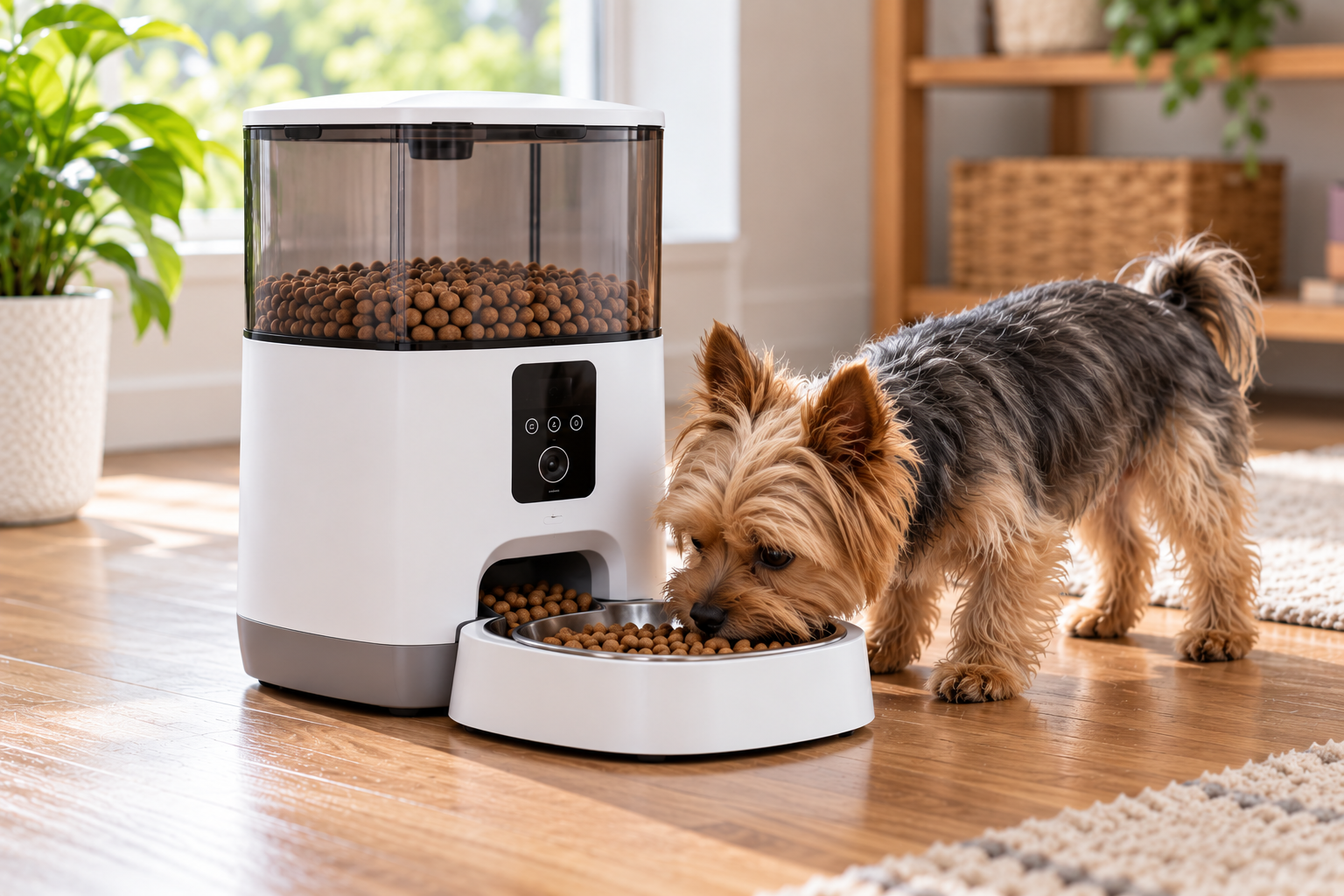
An automatic pet feeder can help keep meals on a consistent schedule when work, commuting, or other commitments make manual feeding difficult.
Depending on the design, these devices can dispense measured amounts of food at programmed times, while connected models may add remote controls and feeding records.
Buying one still takes some research. Capacity, food compatibility, portion settings, cleaning, power backup, and reliability can matter far beyond extras such as cameras or recorded messages.
This guide explains what to compare so you can find a feeder that suits your pet and daily routine.
What Is an Automatic Pet Feeder and How Does It Work?
An automatic pet feeder stores or holds food and releases it according to a programmed feeding schedule. Hopper-style models commonly handle dry kibble, while other designs use individual compartments for scheduled meals.
A basic timed pet feeder typically lets you program meals directly through controls on the device. Connected models can provide phone-based scheduling, remote dispensing, alerts, and feeding histories, depending on the manufacturer and model.
The important point is that automatic feeders differ significantly in how they dispense and measure food.
Before buying, check the manufacturer’s instructions for compatible food types, kibble dimensions, serving increments, and cleaning requirements.
Which Type of Feeder Fits Your Routine?
Your pet’s food type and feeding habits should narrow your choices quickly.
| Feeder Type | May Suit | Points to Check |
|---|---|---|
| Timer-based feeder | Predictable daily schedules | Meal settings, controls, power source |
| Hopper feeder | Pets eating compatible dry kibble | Kibble dimensions, hopper capacity, dispensing mechanism |
| App-controlled feeder | Owners wanting remote controls | Wi-Fi requirements, app functions, offline operation |
| Compartment feeder | Individually prepared meals | Number of compartments, food compatibility, cleaning |
| Access-controlled feeder | Multi-pet households | Identification system and pet compatibility |
Most hopper-style automatic feeders are intended primarily for dry kibble. Wet or semi-moist foods can require a feeder specifically designed to handle those foods, potentially with sealed or cooled compartments.
Automatic Cat Feeder
An automatic cat feeder can be useful when your cat eats several scheduled meals throughout the day. Look closely at the smallest available serving setting, especially if your cat receives relatively small meals.
For homes with several cats, scheduled dispensing alone may not prevent one animal from eating another’s meal. Some access-controlled systems use RFID tags or microchip recognition to restrict bowl access.
Automatic Dog Feeder
When researching an automatic dog feeder, check bowl size, hopper capacity, stability, and compatible kibble dimensions. A feeder designed around small kibble and small servings may not suit a larger dog.
Physical security matters too. Check the lid, dispensing chute, and base to see how easily an inquisitive pet could tip the unit or reach stored food.
How Important Is Portion Control?
Portion settings deserve close attention because manufacturers can define a “portion” differently. A feeder that advertises many portion levels does not necessarily dispense the same amount per level as another model.
A pet feeder with portion control should let you select an amount that closely matches your pet’s established feeding plan. Some feeders measure food volumetrically rather than by weight, so the actual weight dispensed can vary with kibble size, density, and shape.
A sensible setup method is to dispense several test meals and weigh them using a kitchen scale. Compare the results with the amount you normally serve.
If your veterinarian has prescribed a specific diet or calorie intake, follow that guidance rather than relying solely on the feeder’s default serving labels.
Smart Pet Feeder vs. Basic Timer: Which Makes Sense?
A smart pet feeder adds connected functions to scheduled food dispensing. Depending on the model, these functions can include remote feeding, schedule adjustments, feeding histories, low-food notifications, cameras, or voice features.
Yet connected functions shouldn’t distract you from basic performance. A feeder still needs to dispense your pet’s food consistently and remain practical to clean.
A straightforward timer model may suit you if your schedule rarely changes. Connected controls become potentially useful when your routine varies and you want to check or adjust feeding settings remotely.
Is a WiFi Pet Feeder Worth Buying?
A WiFi pet feeder may suit households that value remote access. Some connected feeders let you change schedules, manually trigger a serving, receive status notifications, or review feeding records from a compatible app.
Before paying extra for connectivity, check:
- Which Wi-Fi networks the feeder supports
- What happens when the internet disconnects
- If programmed schedules are stored locally
- Which functions remain available offline
- What notifications the app provides
- If any advertised functions require a subscription
Ideally, loss of internet access shouldn’t prevent a previously programmed meal from being dispensed. Verify this behavior in the manufacturer’s documentation for the exact model you’re researching.
Why Food Compatibility Deserves Attention
One of the easiest purchasing mistakes is assuming any dry food will work with any hopper feeder.
Manufacturers may specify minimum and maximum kibble dimensions. Pieces that are unusually large, irregular, oily, or differently shaped can behave differently inside a dispensing mechanism.
Check your current food against the feeder’s documented compatibility range before buying. This is particularly important if your pet eats larger kibble, prescription food, freeze-dried pieces, or food with irregular shapes.
Check the Hopper Capacity Carefully
A larger hopper reduces how frequently you need to refill the feeder, yet capacity alone doesn’t tell you how long the stored food will last.
Your pet’s daily intake determines that.
Instead of choosing the biggest hopper automatically, calculate roughly how much food your pet eats during your preferred refill period. You should also think about how the storage compartment seals and how easily you can clean it.
For extended storage, follow the pet-food manufacturer’s storage instructions rather than assuming the feeder will keep food fresh indefinitely.
Battery Backup Can Matter During Power Interruptions
For mains-powered feeders, backup power is worth checking carefully. Some models support batteries that allow scheduled dispensing to continue during an outage.
Don’t assume the phrase “battery compatible” means every function continues normally. Manufacturer documentation should tell you which functions operate under backup power.
Questions worth checking include how many batteries are required, if batteries are supplied, if scheduled dispensing continues, and how the feeder indicates low battery levels.
How Easy Is the Feeder to Clean?
Food-contact areas collect crumbs, dust, oils, saliva, and food residue, so cleaning design deserves as much attention as electronic features.
Removable bowls, hoppers, lids, and dispensing components can make routine maintenance easier. Some models use stainless-steel bowls or removable food-contact components, though cleaning instructions vary by manufacturer.
Check the manual before putting any component in a dishwasher. A removable part isn’t automatically dishwasher-safe.
Features Worth Comparing Before You Buy
Focus first on functions that affect everyday feeding:
Meal scheduling: Check how many meals can be programmed and if each meal can have its own serving amount.
Dispensing mechanism: Check compatible kibble dimensions and any manufacturer-described anti-jam system.
Backup power: Find out what continues operating during a power failure.
Food storage: Review hopper capacity, lid security, and sealing design.
Cleaning: Check which food-contact components detach and how they should be washed.
Pet resistance: Look at lid locks, base stability, controls, and access to the dispensing chute.
Connected controls: For app-enabled units, review offline operation and notification functions.
Cameras, voice recordings, and two-way audio can be convenient, yet they don’t compensate for poor food compatibility or unreliable dispensing.
When Might an Automatic Feeder Be Useful?
Scheduled feeders can make practical sense when you leave home before your pet’s normal mealtime, work irregular hours, need several smaller scheduled servings, or want greater consistency in a daily feeding routine.
They can also reduce the need to manually dispense every meal.
However, an automated device doesn’t remove the need to check your pet, water supply, food supply, feeder condition, and general wellbeing. Mechanical or electrical devices can fail, food can jam, and settings can be entered incorrectly.
Questions to Ask Before Purchasing
Can the feeder handle wet food?
That depends on the design. Many hopper feeders are designed for dry kibble. Wet-food models generally use compartment-style designs and may incorporate cooling features. Check the manufacturer’s stated food compatibility.
Will it work if Wi-Fi goes down?
Some connected feeders retain programmed schedules locally, allowing scheduled meals to continue without an active connection, while remote functions may become unavailable. Confirm offline behavior for the specific product.
How do you know the serving size is accurate?
Test the feeder using your pet’s actual food and weigh several dispensed servings. Because many feeders measure by volume, results can differ depending on the kibble.
Can you use one feeder for multiple pets?
You can in some households, though shared access makes individual intake harder to control. If pets need different diets or one tends to steal food, separate or access-controlled feeding systems may be easier to manage.
Matching an Automatic Pet Feeder to Your Feeding Schedule
Start with your pet rather than the longest feature list. Write down the food type, kibble dimensions, usual serving amount, number of daily meals, and the length of time you want between refills.
Then compare feeders based on dispensing reliability, serving flexibility, food compatibility, cleaning access, power backup, and physical security. Connected functions can come after those essentials.
If you’re comparing products now, check current automatic feeder options and manufacturer specifications before choosing a model.
A suitable feeder should fit the routine you already want for your pet. Test the settings after setup, verify actual serving amounts, and periodically check that the dispenser is operating as expected
Leave a Reply